
Estimated read time: 12 minutes
Introduction
I’ll be honest with you, I was in complete denial for almost a year.
Luna had always been a big cat. That’s kind of the whole thing with Maine Coons, right? They’re massive, fluffy, majestic creatures, and I told myself that every time she seemed a little… rounder. “She’s just bigboned,” I’d say. “She’s still growing.” (She was four years old. She was not still growing.)
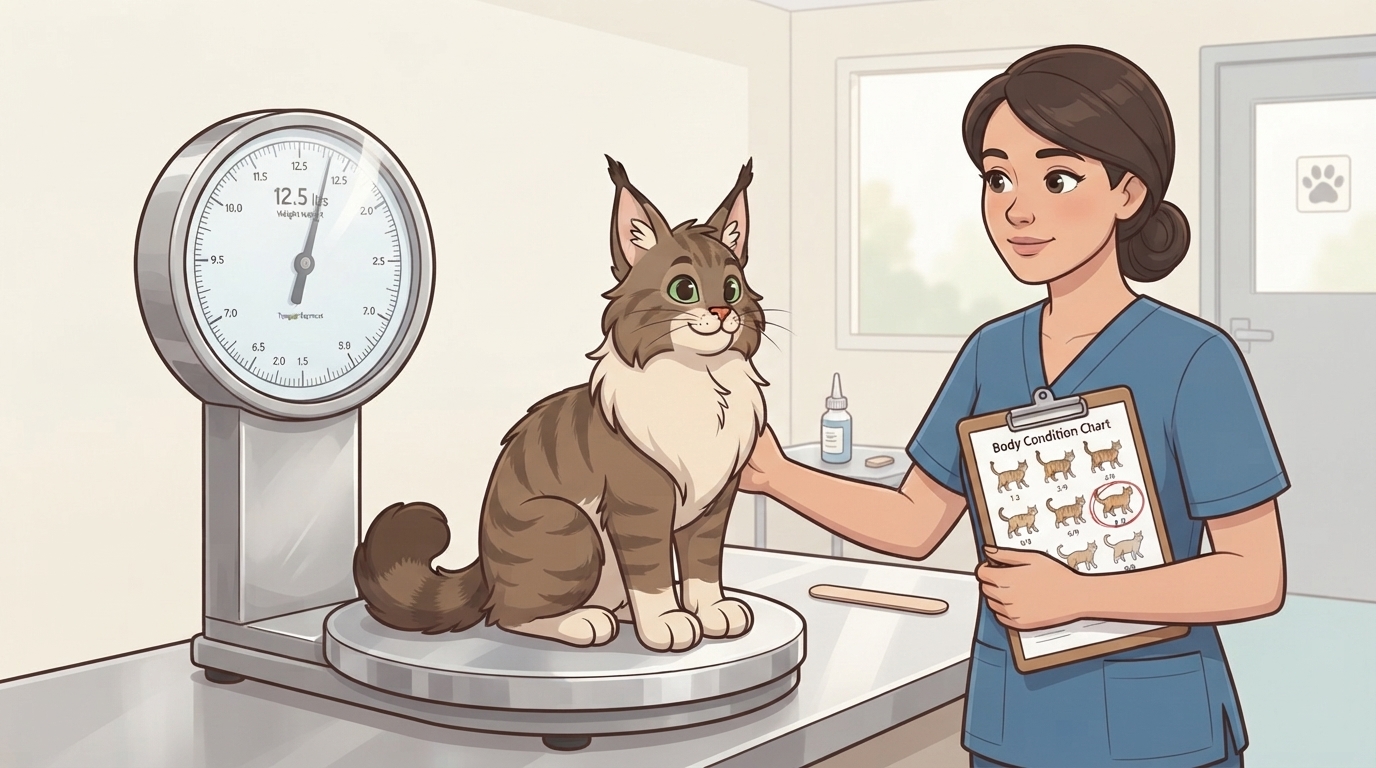
It wasn’t until her annual vet checkup that Dr. Smith gently pulled up a body condition chart and pointed to where Luna landed on it a solid 7 out of 9, when she should’ve been a 5 that I had to face the music. My Maine Coon was overweight, and I had absolutely missed it because I was so used to her already being large.
If you’re asking “is my Maine Coon overweight?” right now, good for you. Seriously. Catching this early or even catching it at all puts you miles ahead of where I was. In this article, I’m going to walk you through exactly how to tell if your Maine Coon is carrying too much weight, what a healthy Maine Coon weight actually looks like, and what steps you can take to help them slim down safely.
What Is a Healthy Weight for a Maine Coon?
Before you can figure out if your Maine Coon is overweight, you need to know what “healthy” actually means for this breed because the numbers are genuinely different from your average house cat.
Maine Coons are one of the largest domestic cat breeds in the world. Males typically weigh between 13 and 18 pounds, and females usually fall between 8 and 12 pounds. Some particularly large males can hit 20+ pounds and still be perfectly healthy. This is the part that trips up so many Maine Coon owners, myself included. When you’ve got a cat that should weigh 15 pounds, it’s really hard to tell when 17 pounds is too much.
Why Maine Coon Weight Is Tricky
Here’s the thing that makes this breed especially tricky, Maine Coons have a slow growth rate. They don’t reach full size until they’re around 3 to 5 years old. So for the first few years of their life, weight gain can genuinely just be growth and then at some point, it tips over into something else.
Luna was 11 pounds at age 2 and 15 pounds by age 4. I thought that was normal growth. What I didn’t realize was that she had fully finished growing by 3 and that last two pounds was mostly… well, extra Luna.
The weight ranges I listed above are guidelines, not gospel. A big framed male Maine Coon might be perfectly healthy at 20 pounds, while a smaller boned female at 14 pounds might actually be overweight. Body condition matters more than the number on the scale. We’ll get to that in a minute.
How to Tell If Your Maine Coon Is Overweight
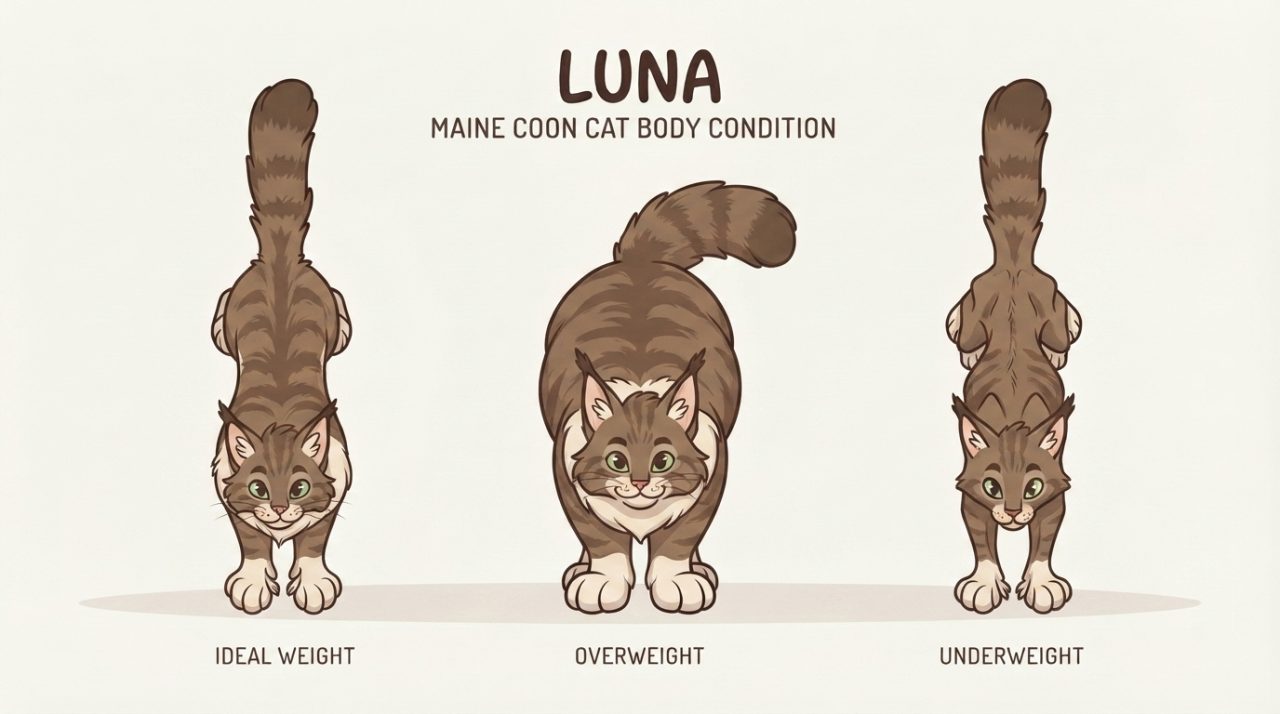
Forget the scale for a second. The most accurate way to assess your Maine Coon’s weight isn’t a number, it’s a body condition score (BCS), and you can do a rough version of this assessment right at home with your hands and your eyes.
Vets use a 9point body condition scale, where 1–3 is underweight, 4–5 is ideal, 6–7 is overweight, and 8–9 is obese. Here’s how to figure out roughly where your cat falls.
The Rib Test
Run your hands along your cat’s sides, pressing gently with your fingertips. You should be able to feel their ribs without pressing hard. They shouldn’t be poking out, but they shouldn’t be buried under a thick layer of fat either.
- Can’t feel ribs at all – Overweight or obese
- Can feel ribs easily with light pressure – Ideal
- Ribs clearly visible or jutting out – Underweight
With Luna, I couldn’t find her ribs without really digging in. That was the first red flag I should’ve noticed much sooner.
The Waist Check
Look down at your cat from directly above. A healthy Maine Coon should have a visible waist and a slight inward curve between the ribcage and the hips. If your cat looks like a rectangle (or worse, a football) from above, that’s a sign there’s extra weight being carried.
The Belly Check
From the side, look at your cat’s abdomen. There should be a slight upward tuck when viewed from the side. If the belly hangs low, swings when they walk, or has a noticeable “pouch” that wobbles, that’s excess fat, not just normal Maine Coon fluff.
Maine Coons do have a primordial pouch (that little skin flap on their belly), which is totally normal and not a sign of obesity. But there’s a difference between a primordial pouch and actual fat deposits. The pouch is loose skin. A fat belly feels more solid and substantial.
The Base of the Tail Test
Feel the base of your cat’s tail and the spine along their back. You should be able to feel the vertebrae and the hip bones without pressing deeply. If these areas feel padded or soft, there’s likely excess fat.
Signs Beyond the Scale – Behavioral Clues Your Maine Coon May Be Overweight
Physical assessment is the most reliable method, but your Maine Coon’s behavior can also give you clues. Here are some behavioral signs I noticed with Luna again, in retrospect that pointed to her carrying extra weight.
Decreased activity and play interest – Luna went from a kitten who would chase a feather wand for 20 straight minutes to a cat who would bat at it twice and walk away. At the time I chalked it up to “she’s older now.” In reality, heavier cats tire out faster and often become less motivated to exercise, which then causes them to gain more weight. It’s a cycle.
Difficulty grooming – Maine Coons are big cats with a lot of fur. When they gain excess weight, they can struggle to reach certain areas particularly the base of their tail, their lower back, and their hindquarters. If you notice your cat’s coat looking matted or unkempt in those areas, and it’s not a recent change, weight could be a factor.
Sleeping more than usual – Yes, cats sleep a lot. Maine Coons typically sleep 12–16 hours a day. But if your cat seems to do almost nothing but sleep, and interactive moments are rare, that can be a sign of lethargy connected to carrying extra weight.
Heavy breathing after minimal activity – An overweight cat shouldn’t be panting or breathing hard after walking across the room or going up the stairs. If you notice labored breathing that seems out of proportion to the activity level, that’s worth a vet visit immediately.
Reluctance to jump – Maine Coons love being up high. If your cat who used to leap to the top of the cat tree now hesitates, takes a lower route, or avoids jumping altogether, excess weight may be making it uncomfortable or difficult.
Health Risks of Obesity in Maine Coons
This isn’t meant to scare you, but I think it’s important to be real about what’s at stake. Carrying excess weight isn’t just a cosmetic issue for Maine Coons it puts real strain on their bodies, and this breed has some breed specific vulnerabilities that make weight management especially important.
Joint and Mobility Issues
Maine Coons are already predisposed to hip dysplasia, a condition where the hip joint doesn’t form properly and can cause pain and mobility problems. Excess weight makes this significantly worse by putting more load on joints that may already be compromised. If there’s any family history of hip dysplasia in your Maine Coon’s line, keeping them at a healthy weight is hands down one of the most important things you can do for their long term quality of life.
Diabetes
Obesity is the number one risk factor for feline diabetes, and Maine Coons already have a slightly elevated genetic predisposition compared to many other breeds. A diabetic cat requires daily insulin injections, careful diet management, and regular monitoring. It’s manageable, but it’s life changing for both of you. Prevention is so much easier than treatment here.
Heart Disease
Maine Coons have a known hereditary risk for hypertrophic cardiomyopathy (HCM), a form of heart disease. Carrying excess body weight puts additional strain on the cardiovascular system and can accelerate the progression of heart problems.
Fatty Liver Disease
Ironically, if an overweight cat stops eating suddenly due to stress, illness, or a crash diet they can develop hepatic lipidosis (fatty liver disease), which is life threatening. This is why you should never put an overweight cat on a steep calorie restriction without veterinary guidance. Weight loss in cats needs to be slow and monitored.

How to Help Your Overweight Maine Coon Lose Weight Safely
Okay here’s the part that actually matters. If you’ve established that your Maine Coon is carrying extra weight, what do you do? I want to be upfront, please loop in your vet. I’m a cat mom sharing my experience, not a veterinarian. That said, here’s what worked for Luna and what I’ve learned along the way.
Step 1 – Get a Vet Baseline
Before making any changes, get your cat weighed and body condition scored by your vet. Ask them to set a target weight and a realistic timeline. For most cats, safe weight loss is 0.5–1% of body weight per week. For Luna at 17 pounds, that was about 0.1–0.17 pounds per week which felt agonizingly slow at the time but was completely right.
Your vet can also rule out medical causes for weight gain, like hypothyroidism (rare in cats but possible) or other hormonal issues.
Step 2 – Measure Every Single Meal
This was the biggest game changer for us. I had been free feeding Luna leaving dry food out all day which is basically an open invitation for overconsumption. Most cats don’t self regulate well, especially indoor cats with not a lot to do.
Switching to measured, scheduled meals gave me control over exactly how many calories Luna was eating. I invested in a small kitchen scale and started weighing her food in grams rather than eyeballing cup measurements, which are notoriously inaccurate.
Portion tip – Read the feeding guidelines on your cat food bag as a starting point, but understand those are often higher than what’s actually appropriate for an indoor, sedentary cat. Ask your vet for a specific calorie target.
Step 3 – Evaluate the Food
Not all cat food is created equal. For weight management, you want a food that is,
- High in protein (40%+ on a dry matter basis)
- Moderate to low in fat
- Low in carbohydrates (especially for dry food)
- Specifically formulated for weight management, if possible
Many vets recommend switching from dry food to wet/canned food for overweight cats, because wet food has significantly higher water content, which adds volume and satiety without adding calories. Luna went from free fed kibble to two measured meals of high protein wet food daily, and within six months she’d lost almost two pounds.
Step 4 – Increase Activity (Strategically)
You can’t out exercise a bad diet, but increasing activity helps and more importantly enriches your cat’s life. Maine Coons are intelligent, active cats who genuinely need stimulation.
Here’s what worked for Luna,
- Interactive play sessions – Two 10–15 minute sessions per day with a wand toy. I put this in my phone calendar like an actual appointment because otherwise I’d forget.
- Puzzle feeders – Instead of just putting food in a bowl, I started using slow feeder bowls and food puzzles that made Luna “work” for her meals. This slowed her eating, engaged her brain, and added a tiny bit of physical activity.
- Cat tree access – Making sure she had a well placed cat tree near a window gave her motivation to climb and lounge at height, which she loves.
- Laser pointer sessions – Quick, intense bursts of activity that get them really moving. Always end with a physical toy they can “catch” so they feel satisfied.
Don’t go from zero to marathon a previously sedentary overweight cat can injure themselves with sudden intense exercise. Start gentle and build up.
Step 5 – Track Progress Monthly
Weigh your cat once a month (not weekly small fluctuations will drive you crazy). Many vet offices will let you bring your cat in just for a weigh in without a full appointment, which is great.
If your cat isn’t losing weight after 4–6 weeks of consistent changes, go back to your vet. You may need to adjust calories further, or there may be an underlying issue to investigate.
What NOT to Do When Your Maine Coon Needs to Lose Weight
A few things to avoid some of which I learned the hard way,
Don’t cut food cold turkey or drastically reduce calories overnight – I mentioned this earlier, but it bears repeating. Sudden calorie restriction can trigger hepatic lipidosis. Weight loss must be gradual. If your cat refuses to eat for more than 24 – 48 hours for any reason, call your vet.
Don’t give extra “healthy” treats and think it doesn’t count – Treats count. Even the “natural” freeze dried ones. Factor them into your cat’s daily calorie budget or cut them out during the weight loss phase.
Don’t compare your Maine Coon to neighbor cats – A 10 pound domestic shorthair being healthy tells you nothing about whether your 16 pound Maine Coon is healthy. Breed matters enormously.
Don’t use human weight loss logic – Cats are obligate carnivores. Cutting fat too drastically, feeding low protein diet foods, or restricting too heavily can cause muscle loss and nutritional deficiencies. Always work with your vet on a plan designed for cats.
Frequently Asked Questions
How can I tell if my Maine Coon is overweight without a vet visit?
The best at home method is the body condition assessment. Feel for your cat’s ribs. They should be easy to feel with light pressure but not visibly prominent. Look at your cat from above for a visible waist tuck, and from the side for an abdominal tuck. If the ribs are hard to find, there’s no waist shape, and the belly hangs low, your cat is likely overweight. That said, a vet visit for an official assessment is always a good idea.
What is a healthy weight for a male Maine Coon?
Male Maine Coons typically weigh between 13 and 18 pounds when healthy, though some large individuals can be healthy at 20 pounds or slightly above. The key is body condition, not just weight a 15pound male with visible ribs and a waist could actually be underweight, while a 17pound male with a round belly and no palpable ribs is likely overweight.
How long does it take for a Maine Coon to lose weight?
Safe feline weight loss is slow, typically 0.5% to 1% of body weight per week. For a 17 pound cat, that’s roughly 0.1–0.17 pounds per week. Expect the process to take several months to over a year depending on how much weight needs to be lost. Patience is key, and rushing it can cause serious health problems.
Can I put my Maine Coon on a diet without talking to a vet?
I’d really encourage you not to. Not because you can’t adjust their food portions, but because an overweight cat needs a calorie target based on their current weight, target weight, and activity level and getting that math wrong can lead to malnutrition or dangerous rapid weight loss. Your vet can also check for underlying health issues that may be contributing to the weight gain.
Is wet food better than dry food for weight loss in Maine Coons?
Generally, yes. Wet food is much higher in moisture, which adds volume and promotes satiety without adding significant calories. It also tends to be lower in carbohydrates, which many feline nutrition experts believe is better suited to a cat’s obligate carnivore biology. Transitioning from free fed dry food to scheduled wet food meals is one of the most effective changes you can make for a cat that needs to lose weight.
Do Maine Coons naturally have a belly pouch? Is that fat?
Maine Coons do have a primordial pouch, a flap of skin along the lower belly that is totally normal and not a sign of obesity. It’s loose, jiggly skin, not fat tissue. The difference is that a primordial pouch feels soft and floppy, while fat deposits feel more solid. You can have both a primordial pouch and excess weight at the same time, which was honestly the case with Luna for a while.
One More Thing Before You Go From One Maine Coon Mom to Another
Getting Luna to a healthy weight was one of the most worthwhile things I’ve done as a cat owner. It wasn’t instant, it took about eight months of careful feeding, more playtime, and regular vet check-ins. But watching her become more active, more playful, and more like the cat she was when she was young? Completely worth every measured meal.
If you’re asking whether your Maine Coon is overweight, you’re already ahead of where I was. Do the at home assessment, book a vet appointment to get a proper baseline, and make a plan. Your big, fluffy, ridiculous cat deserves to feel their absolute best for as long as possible.
Got questions, or have you been through this with your own Maine Coon? Drop a comment below. I read every single one. And if you found this helpful, share it with a fellow Maine Coon parent who might need it.
Nellie J. Wilson, Editor & Maine Coon Mom
