
Introduction
I’ll be honest with you when I first brought Luna home as a kitten, I had absolutely no idea what I was getting myself into with her coat. I figured, hey, cats groom themselves, right? How hard can it be? Fast forward three months, and I was sitting on the bathroom floor at 10 p.m., trying to detangle a mat the size of a golf ball from behind her ear while she shot me a look that could curdle milk.
Here’s what nobody tells you upfront: learning how to groom a Maine Coon at home is one of the most important skills you’ll develop as an owner. Maine Coons are magnificent. That thick, flowing coat is a huge part of why we fall in love with them. But it doesn’t maintain itself. And if you let things slide, you’ll be dealing with mats, tangles, and a very grumpy cat before you know it.
The good news? It’s completely manageable. I’ve been grooming Luna at home for years now, and what used to be a stressful ordeal has turned into one of our favorite bonding rituals. In this guide, I’m going to walk you through everything, tools, technique, frequency, bathing, nail trimming, ear care, and how to make the whole process less of a wrestling match and more of a spa day. Let’s do this.
Why Grooming a Maine Coon Is Different From Other Cats
Before we get into the how to, let’s talk about why Maine Coons specifically need dedicated grooming attention because it genuinely is different from short haired breeds.
Maine Coons have a semi long, multi layered coat made up of a dense undercoat and longer guard hairs on top. That combination is what gives them that gorgeous, lion like mane and fluffy tail. But it’s also what makes them prone to matting, especially in areas with dense undercoat behind the ears, under the “armpits” (yes, that’s a real problem zone), along the belly, and where the legs meet the body.
Unlike a short haired cat who can mostly handle their own grooming, Maine Coons almost always need human help to keep their coat neat and tangle free. And coats vary by individual cat. Some Maine Coons have silkier fur that stays relatively manageable. Others Luna included have what groomers call a “cottony” coat that mats up if I skip even a few days. If your cat is in that second camp, regular grooming isn’t optional. It’s non-negotiable.
Beyond the aesthetics, regular grooming is genuinely good for your cat’s health. It reduces hairballs, lets you catch skin irritations or lumps early, keeps their nails from overgrowing, and maintains their ear hygiene. Think of it as preventive care you can do from your living room.
Essential Grooming Tools Every Maine Coon Owner Needs
You don’t need a professional salon setup, but having the right tools makes a massive difference. Using the wrong brush on a Maine Coon is like trying to rake leaves with a fork. Here’s what I keep in Luna’s grooming basket.
The Must Haves
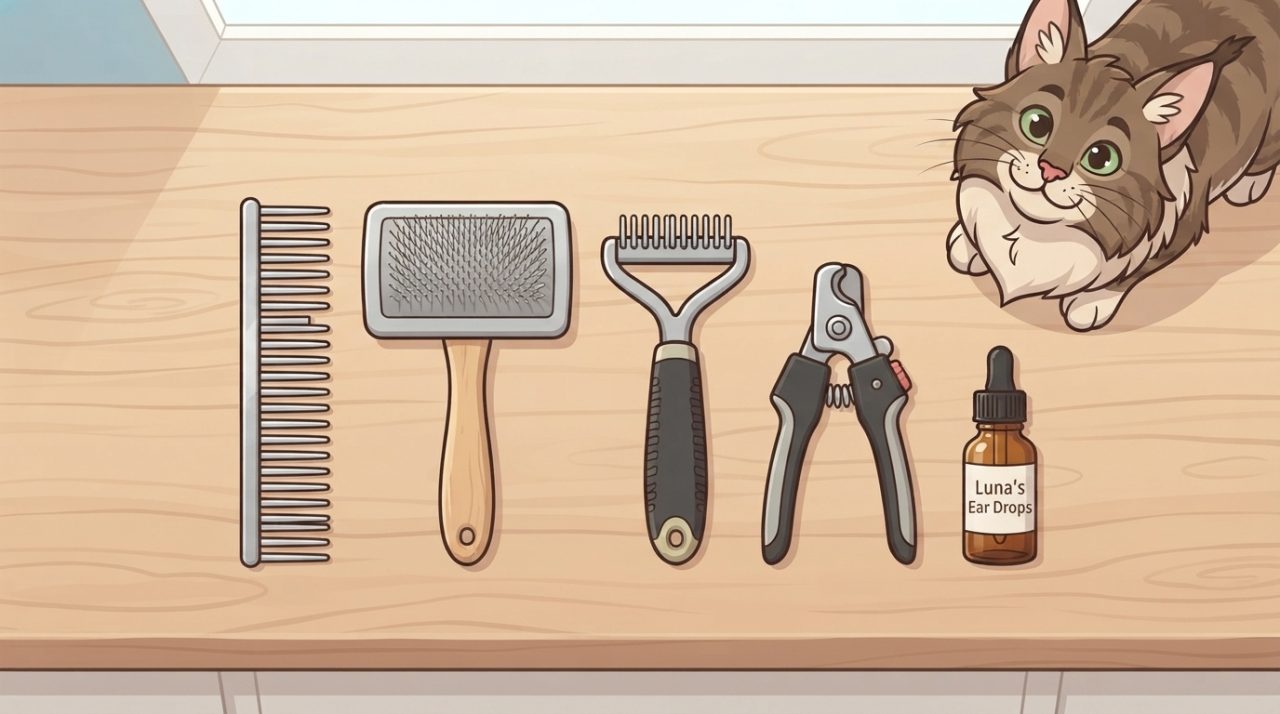
Wide tooth stainless steel comb This is your number one weapon. A stainless steel wide tooth comb is the most effective tool for working through a Maine Coon’s dense, layered coat, it gets down into the undercoat without ripping at the fur. I use this first, before anything else.
Slicker brush After you’ve combed through the tangles, a slicker brush is fantastic for surface grooming removing loose fur, smoothing the coat, and giving it that beautiful fluffy finish. The fine, closely spaced wires pick up loose hairs efficiently and help prevent mats from forming on top.
Undercoat rake or dematting comb If your Maine Coon has a thicker coat (or it’s shedding season), an undercoat rake is a game changer. It looks like a small razor on a handle, it detangles and reduces shedding without cutting healthy fur.
Deshedding gloves I discovered these later in my grooming journey and I genuinely can’t believe I lived without them. Slip them on, pet your cat and you’re pulling out loose fur the whole time. Luna loves being “petted” with these because she doesn’t even realize she’s being groomed. Bonus: they’re great for getting fur off your couch, too.
For Nail, Ear, and Teeth Care
Cat nail clippers Either scissor style or guillotine style both work. Just make sure they’re sharp. Dull clippers crush rather than cut, which is uncomfortable.
Cat safe ear cleaning solution and cotton balls For routine ear maintenance. Never cotton swabs. I’ll explain why later.
Cat safe enzymatic toothpaste and finger brush or pet toothbrush Often overlooked, but dental hygiene matters.
Cat safe shampoo For those occasional bath days. Never use human shampoo, as it can strip your cat’s skin of its natural oils and cause irritation.
How to Groom a Maine Coon at Home: Step by Step
Okay here’s the core of it. I’m going to break this down into a logical sequence so you always know what to do and in what order.
Step 1: Set the Scene
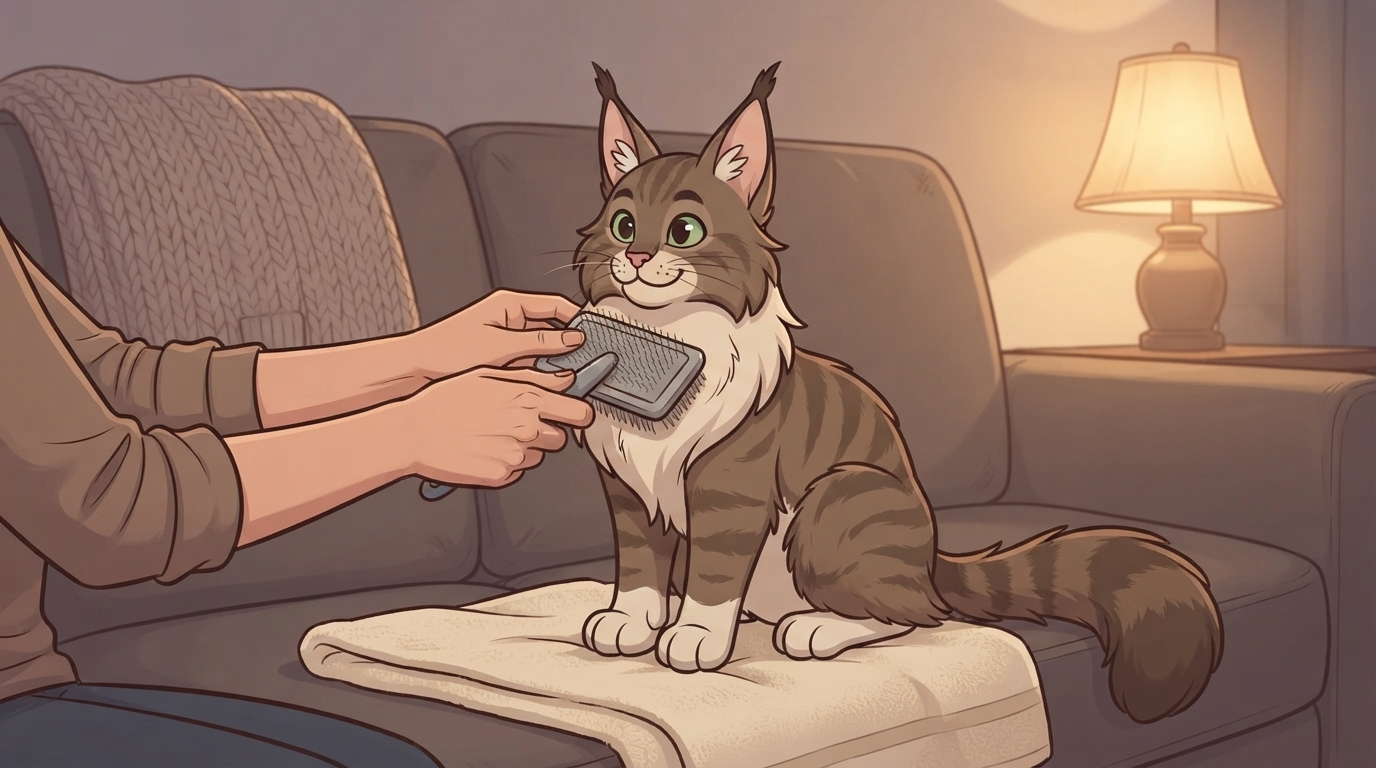
Timing and environment matter more than most beginners realize. Never try to groom a Maine Coon who’s in a hyper, playful mood you’ll lose. Wait until after a meal, when they’re relaxed and a little drowsy. I usually groom Luna in the evening after dinner, when she’s already settled on her favorite blanket.
Pick a consistent spot. I use the couch with a towel on my lap. Luna now associates that setup with grooming time, which means she’s calmer before I even pick up a brush. Consistency is your friend here.
If your cat is new to grooming, start with very short sessions even just two or three minutes and gradually build up over weeks. The goal is to get them used to being handled before you’re trying to tackle a full coat session.
Step 2: Do a Quick Visual Check
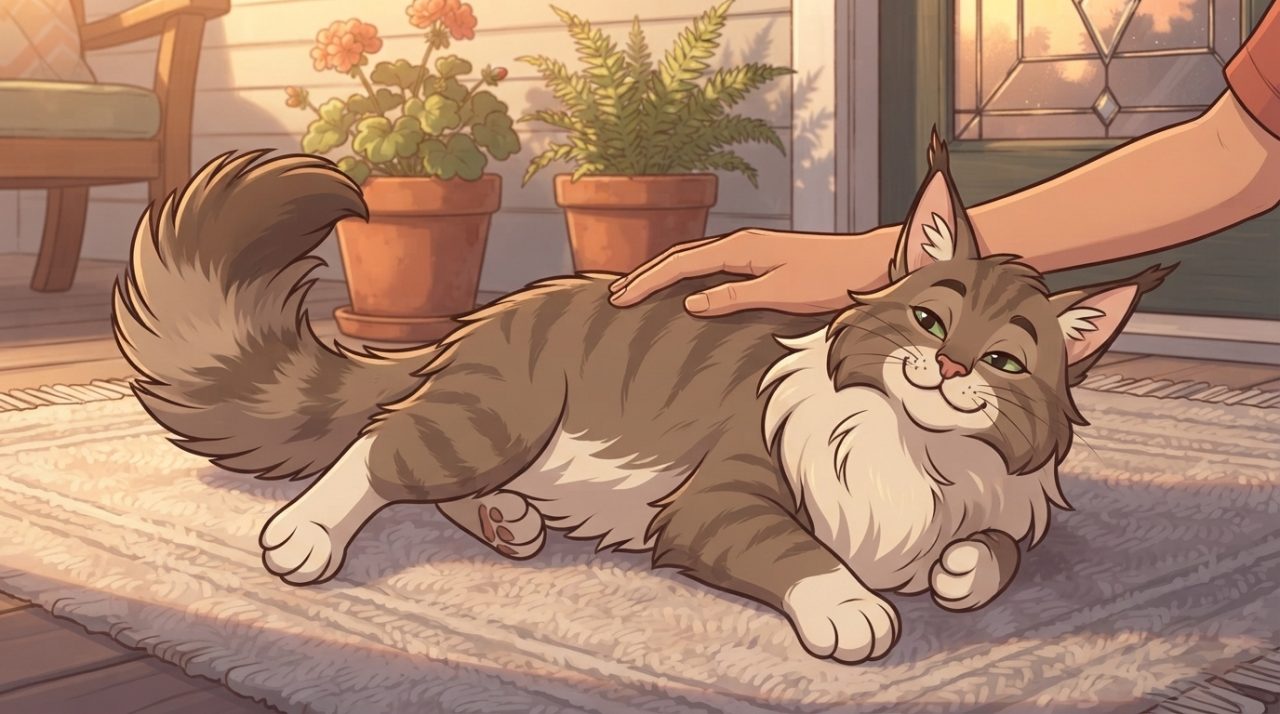
Before you pick up any tool, run your hands over your cat’s coat slowly. You’re feeling for:
- Mats or tangles especially behind the ears, under the front legs, along the belly, and near the base of the tail
- Skin irritation redness, flakiness, or any bumps you haven’t noticed before
- Lumps or tender spots if your cat flinches when you touch somewhere specific, note it and mention it to your vet
This two minute check has helped me catch early skin issues on Luna twice. You know your cat’s body better than anyone else, and regular grooming is what keeps you in tune with it.
Step 3: Start with the Wide Tooth Comb
Start from the head and work your way toward the tail, following the direction of hair growth. Go slowly and gently, you’re not trying to yank out tangles, you’re working through them.
Focus on the problem zones first behind the ears, the ruff around the neck, under the front legs, and the belly. If you hit a knot, don’t pull. Hold the fur at the base with your fingers (close to the skin) to take the tension off, and work through the tangle in small strokes from the tip of the mat inward toward the skin. This prevents pulling on the skin and causing pain.
If a mat is too tight to comb out, don’t force it. See the mat handling section below.
Luna used to absolutely hate having her belly combed, and I had the scratch marks to prove it. Over time, I started doing the belly last (after she was already relaxed from the rest of the session) and paired it with treats. Now she tolerates it, even if she doesn’t love it.
Step 4: Follow With the Slicker Brush
Once the comb has cleared the tangles, go over the whole coat with your slicker brush. This picks up loose fur, smooths the guard hairs, and gives the coat that gorgeous, fluffy finish. Work head to tail again, brushing in the direction of hair growth.
Pay extra attention to the tail Maine Coon tails are spectacular and worth taking care of. A few gentle passes with the slicker brush makes it look like a plume.
This is also a great time to use your deshedding gloves. Just switching to them for the last couple of minutes lets you “pet” your cat while pulling out any remaining loose fur, most cats will start purring at this point, which is a very satisfying sign that you’re doing it right.
Step 5: Handle Any Mats Safely
Mats happen to everyone. Don’t feel like you’ve failed as a cat parent when you find one. The key is dealing with them correctly so you don’t hurt your cat or damage the coat.
Small, loose mats: Hold the fur at the base of the mat with your fingers to anchor it, then work through it slowly with your wide tooth comb, starting at the outer edges and working inward. Detangling spray can help here spray a little on the mat and let it sit for 30 seconds before combing.
Tight, stubborn mats: Do not try to rip through these. Use a mat splitter or dematting comb, which is designed to cut through the mat without cutting the surrounding fur. Work in small sections.
Mats you can’t safely remove: Sometimes a mat is too tight, too close to the skin, or in a sensitive area. In that case, it’s better to carefully snip it off with blunt tipped safety scissors. Hold the mat away from the skin, place a fine tooth comb flat against the skin between the mat and your scissors, and snip above the comb. That comb is your safety net and it protects the skin while you cut. If you’re nervous about this, take your cat to a groomer. No shame in it. I’ve done it myself when Luna had a particularly gnarly mat behind her ear one winter.
How Often Should You Groom a Maine Coon?
This is one of the most common questions I get, and the answer is: it depends on your individual cat’s coat. But here’s a general framework that works well:
- Brushing: At minimum, once a week. Ideally 2–3 times a week, especially during shedding seasons (spring and fall). If your cat has a cottony coat, daily brushing during heavy shed periods will save your sanity.
- Bathing: Only when necessary which for most indoor Maine Coons is once every month or two at most. Over bathing strips natural oils from their coat and skin.
- Nail trimming: Every 2–4 weeks, depending on how fast your cat’s nails grow and whether they use a scratching post regularly.
- Ear cleaning: Once a month for routine maintenance, or whenever you notice visible wax buildup.
- Teeth brushing: Ideally a few times a week, though even once a week is far better than nothing.
During heavy shedding seasons, I bump Luna’s brushing up to daily sessions even just five minutes a day keeps the mats from forming and keeps my vacuum cleaner from developing an existential crisis.
How to Bathe a Maine Coon at Home
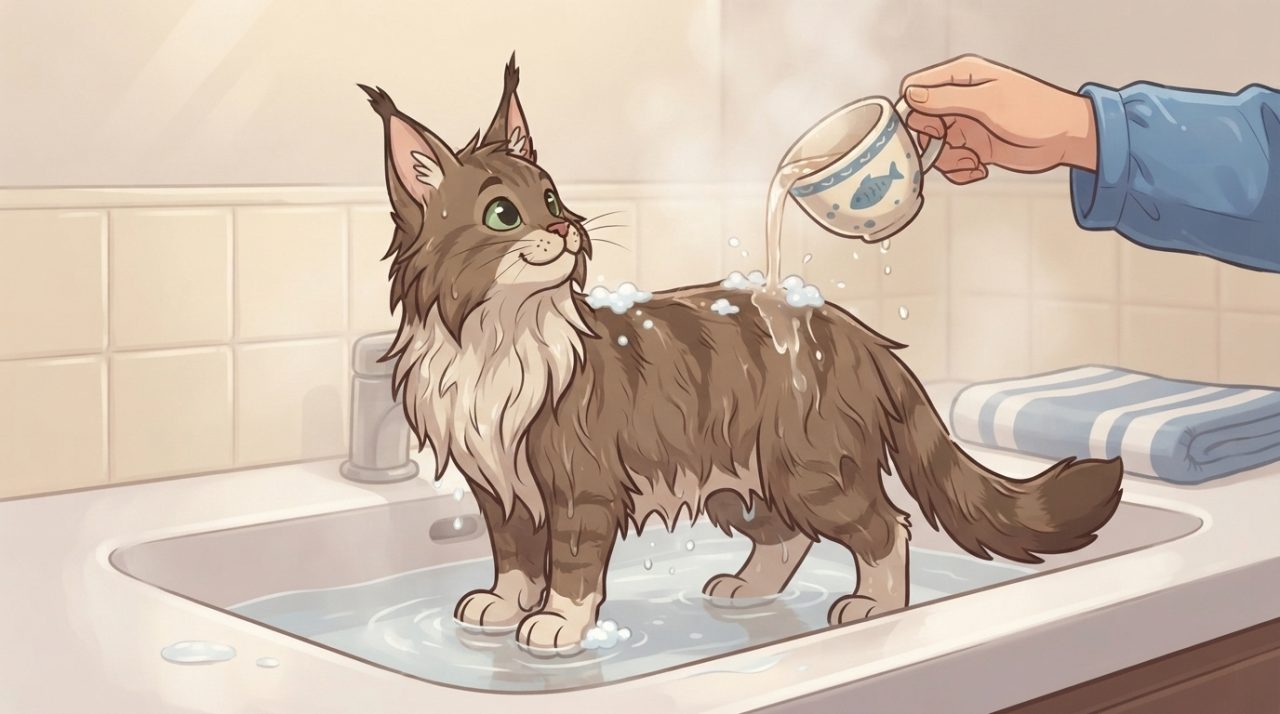
Full disclosure: the first time I bathed Luna, I ended up wearing more water than she did. Bathing a large, opinionated cat is an experience. But it gets easier I promise.
Most Maine Coons actually handle water better than other breeds, thanks to their semi water resistant coat. Some genuinely enjoy it. Luna falls somewhere in the “tolerates it with dignity” category.
Here’s how to make it go smoothly:
Before the bath: Brush your cat thoroughly to remove mats and loose fur. Mats that get wet become much harder to remove, so clear them first. Trim nails before bathing too for your own safety.
Water temperature: Warm, not hot. Test it on your wrist like you would a baby’s bath. Fill the tub or sink only to leg height enough to rinse, but not deep enough to stress your cat.
Shampoo: Always use a cat safe shampoo. Avoid anything with harsh fragrances or human hair products that can irritate their skin and eyes. Dilute the shampoo slightly before applying for easier rinsing.
Washing: Work from the neck down, avoiding the face and ears. Use your hands to massage the shampoo through their coat, being gentle around sensitive areas. Keep your movements calm and speak in a low, reassuring voice. Luna does much better when I’m narrating what I’m doing to her in a soothing tone. I’m not sure if she understands me, but it seems to help.
Rinsing: This is the most important step. Rinse thoroughly until the water runs completely clear. Shampoo residue left in the coat can cause itching and skin irritation.
Drying: Wrap your cat immediately in a large, warm towel and blot (don’t rub) the fur. You can use a hair dryer on the lowest heat setting if your cat tolerates the noise, hold it at a safe distance and keep it moving. Many cats will accept this once they’re used to it. Luna actually walks toward the dryer now because she knows it’s warm. If your cat is panicked by the dryer, stick with towel drying and keep them in a warm room until they dry naturally.
Nail Trimming: The Technique That Actually Works
I won’t sugarcoat it, nail trimming is the grooming task most beginners are scared of, and fair enough. The key is to go slow and only trim the tips.
What you’re looking for: The clear, curved part of the claw that’s what you’re trimming. Inside the nail is the “quick,” a pink vein that will bleed if you cut it. Avoid the quick. When in doubt, trim less rather than more. A small trim every few weeks beats an accidental quick cut every time.
The technique:
- Get your cat relaxed ideally in your lap after a meal.
- Hold their paw gently and press the toe pad down and away to extend the claw.
- Look for the quick (the pink area) before cutting.
- Snip just the sharp tip of the translucent curved end.
- Release, praise, treat.
Do one paw, let them walk away if they want, then come back for another. You don’t have to do all four paws in one sitting. Luna and I usually do two paws at a time, with a treat break between each one.
If you do accidentally nick the quick, stay calm. Apply a little styptic powder or cornstarch to the tip and hold it there for 30 seconds. It’ll stop bleeding quickly. Your cat may be annoyed but they’ll be fine.
A scratching post is also your friend here it naturally files the nails between trims and can reduce how often you need to clip.
Ear and Dental Care: The Often Skipped Steps
These two are the most commonly skipped parts of home grooming, and they genuinely matter for your cat’s long term health.
Ear Cleaning
Maine Coons can accumulate wax and debris in their ears, and if it builds up, it can lead to infections. Once a month, take a good look at the outer ear. It should be clean and pink with no odor.
To clean: dab a cotton ball with a vet approved cat ear cleaning solution and gently wipe the outer folds of the ear. Don’t push anything deeper into the ear canal. The rule I follow is: if you can’t see it, don’t touch it.
Warning signs that need a vet, not a cleaning cloth: dark discharge, a bad odor, your cat shaking their head frequently or scratching at their ears. These can indicate infection or ear mites.
Dental Care
Most cat owners skip this completely, but dental disease is one of the most common health issues in cats. Regular toothbrushing even once or twice a week makes a significant difference over the long term.
Use a cat specific enzymatic toothpaste (they come in flavors like poultry or fish, and Luna is unreasonably enthusiastic about the chicken one) and a finger brush or small pet toothbrush. Let your cat lick the toothpaste off your finger first so they associate it with something tasty. Gradually introduce the brush and work up to actual brushing in short sessions.
You don’t need to brush every tooth, every time. Focus on the outer surfaces of the back teeth, where tartar tends to build up. Even an imperfect brushing is better than none.
When to See a Professional Groomer
Home grooming is absolutely doable for most Maine Coon owners, but there are times when a professional is the right call. Don’t feel like you’ve failed if you need backup even experienced owners use groomers.
Consider a professional session when:
- Your cat has extensive matting that’s too widespread or close to the skin to safely handle at home
- Your cat becomes extremely stressed or aggressive during grooming (this isn’t good for them or you)
- You want a “lion cut” or major coat trim for summer
- You’d like a trained eye to check for early signs of skin conditions, abnormal shedding, or other issues
Professional groomers recommend Maine Coons come in roughly every 2–3 months for a full session, more often during heavy shedding seasons. Pair that with regular home maintenance and your cat’s coat will be in great shape year round.
Frequently Asked Questions
How often should I brush my Maine Coon?
At minimum, once a week but 2–3 times per week is ideal for most Maine Coons, especially those with thicker or cottony coats. During spring and fall shedding seasons, daily brushing (even just 5–10 minutes) is highly recommended to prevent mats and manage loose fur.
Do Maine Coons need baths?
Not regularly, no. Most indoor Maine Coons do a good job staying clean on their own, and over bathing can strip their coat of natural oils. Bathe your Maine Coon when they’re visibly dirty, smelly, or have a skin condition which for many cats is once every month or two at most.
What’s the best brush for a Maine Coon?
A stainless steel wide tooth comb for detangling and undercoat work, paired with a slicker brush for finishing and loose fur removal. For heavy shedding periods, add an undercoat rake or dematting comb to your kit.
How do I stop my Maine Coon from hating being groomed?
Start young if possible, keep sessions short, pair every session with treats and praise, and always groom when your cat is relaxed (not hyper). Be consistent, cats adapt quickly to predictable routines. Avoid restraining them forcefully; work with their mood, not against it.
Can I cut out mats myself?
You can, with caution. Use blunt tipped safety scissors and always place a fine tooth comb flat against the skin between the mat and the scissors before cutting this protects the skin. If you’re nervous or the mat is large and close to the skin, take your cat to a professional groomer.
How do I trim a Maine Coon’s nails at home without hitting the quick?
Only clip the clear, curved tip of the nail, not the pink area (the quick) visible inside. Press the toe pad down to extend the claw, look before you cut, and trim conservatively. If in doubt, less is more. Use styptic powder if you accidentally nick the quick.
One More Thing Before You Go From One Maine Coon Mom to Another
Grooming a Maine Coon at home really does get easier with time. I say this as someone who started out completely clueless, covered in cat fur, and genuinely questioning my life choices. Now, Luna’s grooming sessions are one of my favorite parts of our routine. She climbs into my lap, I work through her coat, she purrs, and for twenty minutes everything else in the world can wait.
The keys are simple: invest in the right tools, establish a consistent routine, work with your cat’s mood rather than against it, and start slow if you’re both beginners. You don’t need to be perfect. You just need to show up consistently.
If you have a Maine Coon kitten, start handling their paws and doing short brushing sessions now you’ll thank yourself in a year. And if you’ve adopted an adult cat who’s never been groomed before, be patient. It may take weeks of slow, positive sessions before they relax into it. Luna took about a month before she stopped treating the slicker brush like a personal threat.
Have a grooming tip that works for your Maine Coon, or a question I didn’t cover here? Drop a comment below. I’d love to hear from you. And if this guide helped, share it with a fellow Maine Coon owner who might be starting out.
Nellie J. Wilson, Editor & Maine Coon Mom
