

Introduction
The first time Luna chirped at a bird through our living room window, I genuinely thought something was wrong with her. I’m talking a rapid fire brr brr brr sound that I had never heard come out of a cat before. I spun around from my laptop, convinced she was in distress, only to find her perched on the windowsill, tail flicking, completely fixated on a sparrow.
That was four years ago. Now? I consider myself fluent in Luna.
If you share your home with a Maine Coon, you already know these cats are not the strong, silent type. Maine Coon vocalizations are a whole language rich, varied, and surprisingly expressive. From the classic chirp to the theatrical yowl that sounds like your cat is narrating a soap opera, every sound has a meaning. And once you start learning to decode them, your relationship with your cat changes completely.
In this guide, I’m breaking down every major Maine Coon vocalization, what it typically means, when to be concerned, and how to respond in a way that actually strengthens your bond. Whether your Maine Coon is a constant chatterbox or a more reserved communicator, this is the article you’ve been looking for.
Why Maine Coons Are So Vocal (And Different from Other Cats)
Before we dive into specific sounds, it helps to understand why Maine Coons vocalize so much in the first place.
Maine Coons are often described as “dog-like” cats, and their communication style is a big reason why. Unlike breeds that tend to be more aloof, Maine Coons were historically working cats, ship cats and farm cats that lived in close contact with humans. Over generations, they developed a strong instinct to communicate with people. They want to be understood. They expect to be heard.
Most domestic cats communicate with other cats primarily through scent and body language. Meowing, interestingly, is something cats largely developed for humans. It’s a sound kittens use with their mothers that adult cats keep using with us because it works. Maine Coons took this to another level. They have a broader vocal range than many breeds and seem genuinely motivated to use it.
What also sets Maine Coon vocalizations apart is their tonal quality. Many Maine Coon owners describe their cats’ voices as higher pitched or more “chirpy” than you’d expect from such a large cat. Luna weighs 14 pounds and sounds like a tiny woodland creature half the time. It’s completely incongruous and absolutely charming.
Another factor: Maine Coons are highly social and emotionally aware. They read the room. When you’re stressed, they’re likely to check in. When you’ve been gone all day, they’ll have things to say. This emotional attunement drives a lot of their vocalization, they’re responding to you and to their environment in real time.
Understanding this context makes it a lot easier to interpret individual sounds. Your Maine Coon isn’t making noise randomly. There’s almost always a reason.
The Chirp and Trill: Your Maine Coon’s Signature Sound
If there’s one vocalization that is quintessentially Maine Coon, it’s the chirp trill. This is the sound that confused me the first time Luna made it, and it’s the one that Maine Coon owners talk about constantly.
What It Sounds Like
The chirp is a short, bright sound somewhere between a meow and a bird call. The trill is a rolling, slightly longer sound, often described as brrrt or a soft motorboat like sound. Many Maine Coons combine these into a chirp trill sequence, especially when they’re excited or greeting someone.
What It Means
Excitement and hunting instinct. When Luna chirps at birds or squirrels through the window, she’s expressing the frustration of seeing prey she can’t reach. It’s sometimes called “chattering” and it’s thought to be a mix of excitement, predatory arousal, and possibly an attempt to mimic prey sounds (though that theory is still debated among animal behaviorists).
A greeting. The trill, in particular, is a greeting sound. Mother cats trill to communicate with their kittens. Adult Maine Coons carry this forward and use it to say hello to you, to other pets, sometimes to themselves as they walk into a room. When Luna trills at me in the morning, it’s the cat equivalent of “good morning, glad you’re here.”
Contentment and conversational filler. Sometimes the trill is just… a comment. Luna will trill when she jumps up next to me, when she walks past, when she finds a particularly comfortable spot to settle. It’s not a demand or a distress signal, it’s just her narrating her life.
How to Respond
Trill back. I’m completely serious. Maine Coons love call and response conversation. When Luna trills at me, I trill back (or do my best approximation of it), and she almost always responds with another trill or a head bump. It sounds silly, but it genuinely deepens the bond. You’re speaking her language.

The Meow: More Nuanced Than You Think
Every cat meows, but not every meow means the same thing. Maine Coons have a surprisingly wide meow vocabulary, and once you tune in, you’ll start to distinguish between them.
The Short, Polite Meow
This is an acknowledgment or a low key request. Luna does this when she wants me to move my feet so she can settle on the couch, or when she’s just checking in. It’s the cat equivalent of a polite “excuse me.”
The Extended, Insistent Meow
This one means business. If Luna wants her breakfast and I’m running late, I get a series of these longer, louder, with obvious rising intonation. This is your Maine Coon saying, I have made a request and you have not fulfilled it and I would like you to know I’ve noticed.
The Soft, Quiet Meow
This is one of my favorites. It’s almost a whisper meow barely audible, very gentle. Luna uses this when she wants attention but isn’t in a demanding mood. It feels like an invitation rather than a request. It often means she wants to be close, not necessarily that she needs something specific.
The Complaint Meow
Sharp, short, slightly indignant. You’ll hear this when you’ve accidentally bumped your Maine Coon, taken too long to open a door, or done something else that they feel warrants a formal protest. It’s not aggressive, it’s just… editorial.
Reading Body Language Alongside the Meow
The meow alone doesn’t tell the full story. Pay attention to what comes with it: tail position (up = happy, puffed = alarmed), ear direction (forward = engaged, flat = unhappy or scared), and posture. A meow paired with a raised tail and slow blinking is very different from the same meow paired with a tucked tail and flat ears.
The Purr: Not Always What You Think
Most of us learn early that purring = happy cat. And often, that’s true. But the purr is more complicated than that, and understanding its nuances matters especially for Maine Coon owners.
The Contented Purr
Deep, rhythmic, steady. This is the purr Luna makes when she’s fully settled, usually on my lap or tucked next to me in bed. It’s the sound of a cat who is warm, safe, and at peace. This is the one you want to hear.
The Solicitation Purr
Research by Dr. Karen McComb at the University of Sussex identified what’s called the “solicitation purr” a purr that embeds a higher frequency cry that humans find hard to ignore. Cats seem to use this specifically to get humans to respond (usually to feed them). Luna has this down to a science. It’s subtly different from the contented purr slightly more urgent, a little less rhythmic. Once you notice it, you can’t un notice it.
The Self Soothing Purr
Cats also purr when they’re stressed, in pain, or unwell. The vibration of purring has actual physiological effects, it can reduce stress hormones and may even promote healing in bone and tissue. If your Maine Coon is purring but seems uncomfortable, hiding, or off their food, don’t assume they’re fine just because they’re purring. Check in with your vet.
Luna had a dental procedure last year, and she purred the entire car ride to the vet which I initially found reassuring until the vet tech explained that cats in discomfort often purr to calm themselves. I felt so naive. Now I pay closer attention to context, not just sound.
The Yowl: When Your Maine Coon Turns Up the Volume
The yowl is unmistakable. It’s long, loud, and has a haunting quality somewhere between a moan and a wail. If you’ve never heard a yowling cat, imagine someone slowly and dramatically expressing existential anguish. That’s pretty close.
What It Typically Means
Hormonal communication. Unspayed females in heat yowl to attract mates. Unneutered males yowl in response or when frustrated. If your Maine Coon isn’t spayed or neutered and you’re hearing frequent yowling, this is almost certainly why. The solution here is obvious.
Territorial dispute. If your Maine Coon can see another cat outside (or even smell one through a window), yowling can be a territorial response. Luna occasionally does this at the neighbor’s cat, who has the nerve to walk through our backyard like he owns the place. She posts up at the window and tells him exactly what she thinks.
Pain or distress. Sudden or frequent yowling in a cat that doesn’t normally yowl is a vet visit trigger, full stop. It can indicate hyperthyroidism, cognitive dysfunction (especially in senior cats), high blood pressure, pain, or neurological issues. Don’t wait this one out.
Disorientation. Senior Maine Coons sometimes yowl particularly at night due to cognitive dysfunction syndrome (CDS), the feline equivalent of dementia. If your older cat is suddenly very vocal at night and seems confused or disoriented, talk to your vet about it.
The Difference Between a Dramatic Maine Coon and a Distressed One
Here’s the thing: Maine Coons can be dramatic. Luna yowled for a full five minutes the one time I accidentally shut her out of the bedroom. She wasn’t hurt. She was offended. But I know her baseline, her normal dramatic range so I could tell it wasn’t distress.
If yowling is new, sudden, persistent, or accompanied by changes in eating, drinking, litter box habits, or movement, always get it checked out.

Chattering, Clicking, and the Hunting Sounds
We touched on this earlier in the chirp section, but it deserves its own deeper look because it’s one of the most fascinating Maine Coon vocalizations and one of the most misunderstood.
What Chattering Actually Is
When your Maine Coon spots a bird, a squirrel, a fly, or even a toy being moved quickly, you might hear a rapid, jaw clicking sound sometimes paired with that chirping trill. The teeth chatter, the jaw moves in rapid, small motions. It looks almost involuntary.
This behavior is often called “chattering” or “clicking” and it’s tied directly to predatory arousal. Some theories suggest it’s a reflex connected to the killing bite, the rapid jaw motion mimics the bite cats use to dispatch prey. Others suggest, it’s frustration. Some researchers think it might even serve as camouflage, with some wild cat species using similar sounds to mimic prey.
Whatever the exact cause, it’s completely normal and extremely entertaining to watch. Luna’s whole demeanor shifts when she goes into chatter mode she becomes intensely focused, almost trance like, tracking whatever has caught her attention.
Should You Do Anything?
Not really, unless your cat seems excessively frustrated by indoor limitations. In that case, window bird feeders (cat TV, basically) give them something to watch, and wand toys can satisfy some of that pent up hunting energy. Luna has a feather wand that she absolutely murders on a regular basis. I consider it mental health maintenance.
Hissing and Growling: Respect the Warning
These are the sounds most cat owners know to take seriously and for good reason.
The Hiss
A hiss is a clear warning: Back off. I feel threatened. It’s an involuntary defense response, not aggression in the attacking sense. Maine Coons hiss when they’re scared, cornered, or suddenly startled. Luna hissed at the vacuum cleaner for the first six months of her life. She no longer does, but she still regards it with deep suspicion.
If your Maine Coon hisses at a person, take it seriously. It means something in that interaction is making them feel unsafe. Don’t punish the hiss, it’s communication. Instead, give the cat space and figure out what triggered it.
The Growl
Deeper and more sustained than a hiss, a growl means “I am at my limit and I am not kidding.” If a hiss is a warning shot, a growl is the escalation before a swipe or bite. Maine Coons generally have calm, tolerant temperaments which means when you do hear a growl, it usually means something genuinely bothered them.
Common triggers: being held when they don’t want to be, being approached by an unfamiliar animal, pain when touched, or resource guarding (food, a favorite spot).
Important note: If your Maine Coon growls when you touch a specific part of their body, this can indicate pain or injury in that area. Don’t push through it. Get it checked.
The Spit
A step beyond the hiss sharper, faster, more explosive. This is the “I am about to be out of options” warning. If you hear a spit, the cat is telling you they are at maximum threat response. Give them space immediately.
Quiet Sounds: The Vocalizations You Might Miss
Not all Maine Coon communication is loud. Some of the most meaningful sounds are the subtle ones.
The “Ack” or Syllabic Meow
Some Maine Coons make a distinct sound that almost sounds like a word, a one syllable chirp meow hybrid that functions as an acknowledgment. Luna does this when I call her name and she doesn’t feel like coming over but wants me to know she heard me. It’s the cat equivalent of “yeah, I heard you, I’ll be there when I’m ready.”
The Breath Meow
A very quiet, almost breathed meow sometimes barely audible. This is usually contentment or a gentle check in. When Luna is half asleep next to me and makes this sound, it reads as “I’m aware you’re here and I approve.”
Clicking While Grooming a Person
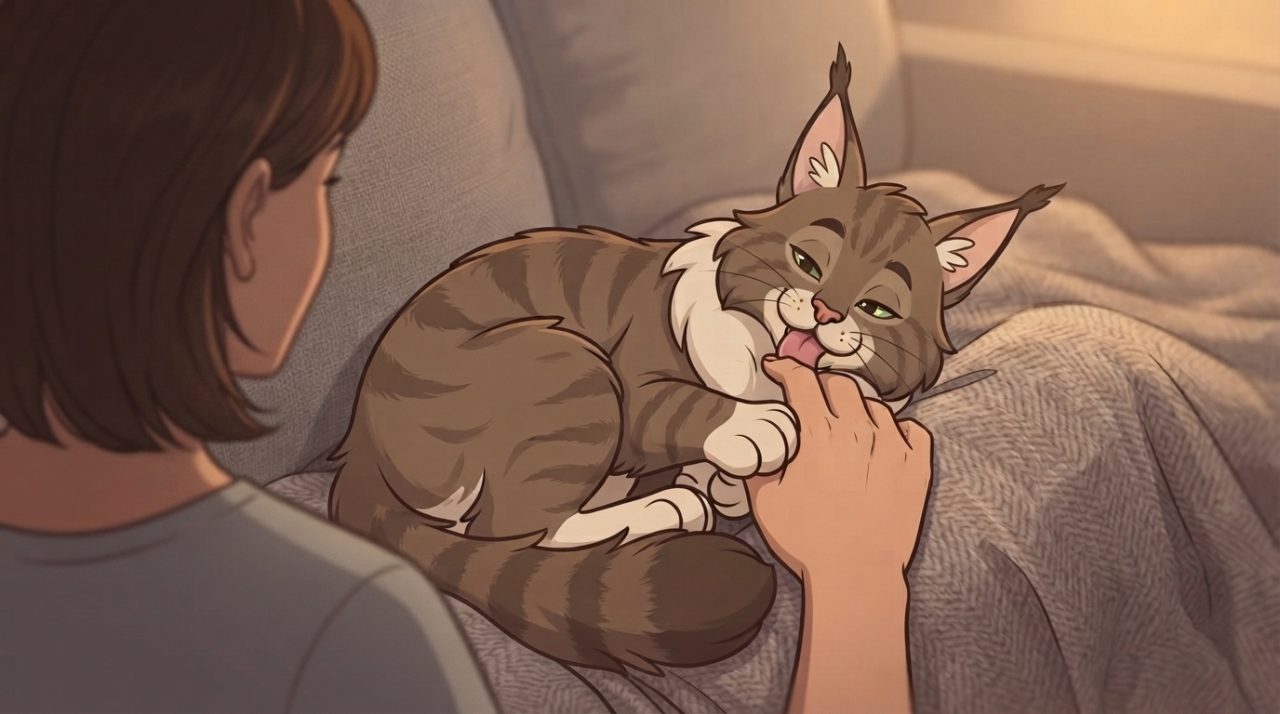
Some Maine Coons make soft clicking or smacking sounds while grooming their humans. This is deeply social behavior. It’s what cats do with cats they trust completely. If your Maine Coon grooms you and makes sounds while doing it, that is next level bonding behavior. You should feel honored.
How Maine Coon Vocalizations Change Over Time
Luna was considerably noisier as a kitten constant chirping, frequent meowing, generally narrating everything. As she’s settled into adulthood, she’s become more economical with her sounds. She knows I understand her, so she doesn’t need to repeat herself as much.
This is common. Kittens vocalize more to establish communication and meet needs. Adult cats often develop a more streamlined “vocabulary” with the specific humans they trust.
That said, changes in vocalization can be a health indicator at any age:
- Suddenly much more vocal: Hyperthyroidism (especially in cats 10+), pain, cognitive changes, anxiety.
- Suddenly much quieter: Upper respiratory infection, laryngeal issues, depression, pain, injury.
- New types of sounds: Worth noting and mentioning to a vet if they persist.
I track Luna’s “normal” pretty closely. Not obsessively just enough that if something shifts, I’d notice.
Building Better Communication with Your Maine Coon
Understanding what your Maine Coon is saying is the first step. Responding appropriately is what builds trust.
Talk Back
Maine Coons love conversation. Narrate your day, respond to their sounds, ask them questions (yes, really). They don’t understand the words, but they understand tone, rhythm, and engagement. Luna follows me around when I’m talking to her, and she responds to my inflection. High, happy voice = she perks up. Calm, low voice = she relaxes.
Learn Their Individual Baseline
Every Maine Coon is different. Some are extremely vocal; some are quieter. Some chirp constantly; others barely chirp at all. The goal isn’t to match your cat to a standard, it’s to know your cat’s normal. That’s what lets you catch changes early.
Respond to Reasonable Requests
If your Maine Coon meows to be let into a room and you let them in, that’s positive communication reinforced. They learn that vocalizing gets a response, which actually makes them more likely to communicate with you and more likely to try before resorting to more dramatic tactics.
Don’t Punish Vocalizations
Even the annoying 4 a.m. variety. (I know. I know.) Punishing vocalization damages trust and doesn’t address the underlying cause. Instead, figure out the why: Are they hungry? Bored? Anxious? In pain? Address the root and the noise usually resolves.
Frequently Asked Questions
Why does my Maine Coon chirp at birds?
Chirping or chattering at birds is a normal predatory behavior. When your Maine Coon spots prey they can’t reach, the combination of excitement and frustration triggers this involuntary jaw clicking sound. It’s completely harmless and very common in the breed.
Is it normal for Maine Coons to be so vocal?
Yes Maine Coons are one of the more talkative cat breeds. Their social nature and strong bonds with humans drive frequent vocalization. If your Maine Coon is vocal, that’s usually a sign of a confident, engaged cat. Sudden changes in vocalization level are worth watching, but baseline chattiness is just part of who they are.
What does it mean when my Maine Coon trills?
A trill is typically a greeting, an expression of contentment, or conversational engagement. Mother cats trill to communicate with kittens, and adult Maine Coons use it with the humans they’re bonded to. If your cat trills at you, feel good about it, it’s a warm, affectionate sound.
Should I be worried if my Maine Coon starts yowling?
It depends. Occasional yowling tied to specific triggers (a cat outside, being shut out of a room) is usually behavioral. But sudden, frequent yowling especially in a cat that doesn’t normally yowl, or in a senior cat warrants a vet visit. It can indicate pain, hyperthyroidism, or cognitive changes.
Why does my Maine Coon make a sound when I call their name?
That “ack” or syllabic chirp meow in response to their name is an acknowledgment. Your cat is saying “I heard you.” Whether they actually come over is, of course, entirely their decision.
Do Maine Coons purr more than other cats?
Maine Coons are known for being affectionate and social, and many owners report their cats purring frequently. The purr’s frequency and quality can vary, but a Maine Coon that purrs often is generally one that feels safe and content in their home.
One More Thing Before You Go From One Maine Coon Mom to Another
After four years of living with Luna, I genuinely can’t imagine a quieter cat. Her running commentary on my day, her morning trills, her very pointed opinions about dinner timing all of it is part of what makes her her. Learning to understand Maine Coon vocalizations isn’t just about managing behavior. It’s about connecting with an animal that is genuinely trying to communicate with you.
The chirps, trills, meows, purrs, and occasional dramatic yowls are all part of a language your Maine Coon is actively using. And the more fluent you become, the richer your relationship gets. Pay attention to the sounds, yes but also to the context, the body language, and the patterns over time. That’s where the real conversation lives.
If you’ve got a particularly vocal Maine Coon with some signature sounds I didn’t cover here, I’d love to hear about them in the comments. Luna has a few specialty vocalizations that I’m pretty sure she invented herself, so nothing would surprise me at this point.
Nellie J. Wilson, Editor & Maine Coon Mom
