

Introduction
When I first started researching Maine Coons before getting Luna, I fell down a rabbit hole at midnight comparing photos of males and females side by side. I genuinely couldn’t believe some of those males were real cats and not small mountain lions. But I also kept reading comments from people saying the females were “more independent” or “easier to manage” and I had no idea what to make of any of it.
Here’s what I wish someone had told me back then, male vs female Maine Coon size differences are very real, and they’re some of the biggest you’ll find in any domestic cat breed. But size is just one piece of the puzzle. The decision of which gender is right for you comes down to your home setup, your lifestyle, your other pets, and honestly your personal preference for a cat who cuddles you on demand versus one who cuddles you on her terms (Luna, I see you).
In this article, I’m going to walk you through exactly how males and females compare in terms of size, weight, growth timeline, and day to day personality. By the end, you’ll have a clear picture of which gender fits your life.
How Big Do Male Maine Coons Actually Get?
Let’s start with the numbers, because they’re genuinely impressive.
Male Maine Coons are among the largest domestic cats in the world and within the breed, they’re noticeably bigger than their female counterparts. Here’s what you can typically expect,
- Weight: 13 – 18 lbs on average, though many males reach 20 – 25 lbs
- Body length: 19 – 30 inches from nose to base of tail (not counting the tail itself)
- Height: Up to 16 inches at the shoulder
Some exceptional males particularly from large breeding lines have tipped the scales at over 30 lbs. (Healthy weight, not overweight, there’s a difference, and your vet can help you figure that out.) The world record holder, Barivel from Italy, measured over 47 inches long including his tail.
I’ll be honest, when I see a big male Maine Coon in person, there’s always a moment of “wait, is that a cat or a dog?” They have this dense, muscular build with huge paws, a wide chest, and a rectangular body shape that makes even medium sized males look substantial. My friend Sarah has a 19-lb male named Biscuit, and watching him walk across her kitchen is genuinely something.
Growth Rate in Males
Here’s something a lot of new owners don’t realize, male Maine Coons take a long time to fully mature. While most domestic cats are done growing by 12 – 18 months, male Maine Coons often don’t hit their full size until 3 to 5 years old. That kitten you bring home at 4 months old? He’s going to keep growing and growing for years.
This extended growth period is part of what makes the breed so unique, but it also means you need to be patient. Don’t panic if your male is 2 years old and seems “average sized.” He’s probably just getting started.
Female Maine Coon Size – Smaller, But Don’t Underestimate Her
Now, “smaller than a male Maine Coon” still means big by any normal cat standard. Here’s what to expect from females,
- Weight: 8 – 12 lbs on average, sometimes up to 14 – 15 lbs
- Body length: 19 – 25 inches (nose to base of tail)
- Height: Around 14 inches at the shoulder
Luna is on the larger end of the female range at about 12.5 lbs, and people comment on her size constantly. “I didn’t know cats could be this big!” is basically her tagline. So yes female Maine Coons are still large cats. They’re just not as imposingly large as males.
Females also reach their full size a bit earlier, typically between 2 to 4 years, though some may still be filling out until age 4. They carry their weight with the same elegant, long-bodied grace as males just in a slightly smaller package.
What Female Maine Coons May Lack in Size, They Make Up For in Presence
I want to be careful not to undersell the girls here. Luna takes up half the couch. She has a full, luxurious coat, massive tufted ears, and a tail that can sweep things off the coffee table at will. If you’re expecting a petite little kitty, a female Maine Coon will still surprise you.
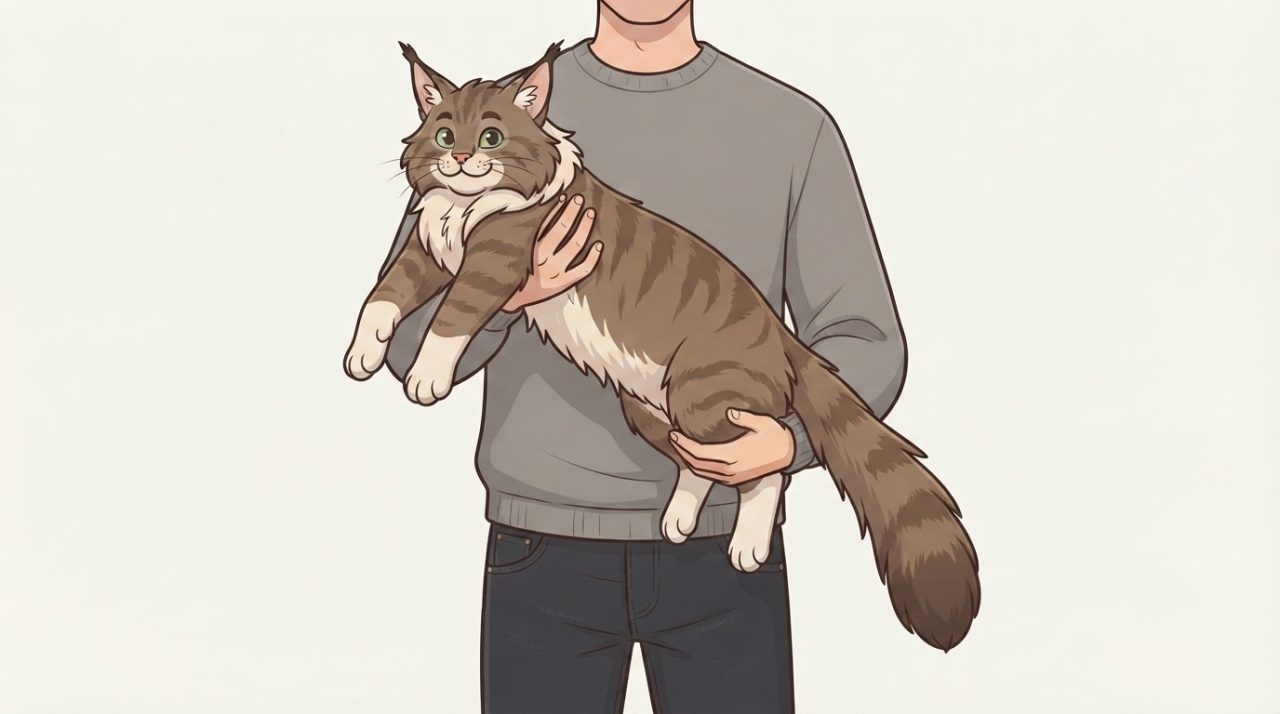
Male vs Female Maine Coon Size – Side by Side Comparison
Here’s a quick reference so you can see the differences at a glance,
Trait | Male Maine Coon | Female Maine Coon |
Average weight | 13 – 18 lbs (up to 25 lbs) | 8 – 12 lbs (up to 15 lbs) |
Body length | 19 – 30 inches | 19 – 25 inches |
Height at shoulder | Up to 16 inches | ~14 inches |
Full maturity | 3 – 5 years | 2 – 4 years |
Build | Broader, more muscular | Leaner, slightly finer-boned |
Overall impression | Imposing, lion-like | Elegant, large-but-graceful |
The weight difference between a large male and an average female can be anywhere from 5 to 10+ pounds which is significant when you’re lifting a cat onto the vet table or feeling them walk across your stomach at 3 AM.
Does Size Affect Personality? What I’ve Noticed
Here’s where it gets interesting and a little controversial, because every cat is an individual. That said, there are some general tendencies that Maine Coon owners and breeders consistently observe.
Male Maine Coon Personality Traits
Males (especially neutered males) are often described as,
- More overtly affectionate – they tend to be the “velcro cats” who follow you from room to room and insist on lap time
- More playful for longer – males often retain kitten-like goofiness well into adulthood
- More socially outgoing – with strangers and other pets
- Slightly more attention seeking – which is charming or exhausting depending on your personality
Biscuit (my friend Sarah’s male) is basically a golden retriever in cat form. He greets every visitor at the door and cries if Sarah’s in another room too long.
Female Maine Coon Personality Traits
Females tend to be,
- More independent – they show affection on their own schedule, which some people find refreshing
- More observant and “regal” – Luna very much has a “I’m watching you, but I’ll come over when I’m ready” vibe
- Equally playful but sometimes more focused – females can be intense hunters and puzzle-solvers
- Slightly more territorial – in multi-cat households (though this varies a lot by individual)
I want to say again, these are tendencies, not rules. Plenty of male Maine Coons are reserved, and plenty of females are total love bugs. Upbringing, socialization, and individual personality matter more than gender in the long run.

Practical Considerations – Living With a Large Male vs a Female
Beyond the personality stuff, the size difference has real practical implications for daily life. This is something I didn’t fully think through before getting Luna, and it’s worth your consideration.
Litter Box
A large male Maine Coon needs a genuinely large litter box. We’re talking jumbo, covered options or better yet, a large storage tote with a cut out entry. Males tend to dig and splash more, and if they can’t turn around comfortably, you’re going to have messes outside the box. Budget for a bigger setup.
Cat Trees and Furniture
Males need sturdier cat trees. A flimsy 40-lb cat tree is not going to work for a 20-lb Maine Coon who launches himself from the top platform. Look for heavy-duty options with wide, stable bases. Luna (at 12.5 lbs) has bent a couple of the cheaper models we’ve tried. I can’t imagine what Biscuit would do to them.
Feeding
Males eat more which means higher food costs over time. Not dramatically more, but it adds up. Luna goes through about one can of wet food per day plus dry food. Males her size or larger often need more. Factor that into your monthly budget.
Vet Care and Handling
Larger cats can be harder to handle at the vet, harder to medicate at home, and may require higher dosing for certain medications. This isn’t a dealbreaker, just something to be aware of especially if you’re older or have mobility considerations.
Which Gender Is Right for You?
Okay, let’s get to the actual question. Here’s my honest breakdown,
Choose a male Maine Coon if,
- You want a big, plush, lion-like cat who is openly affectionate
- You love the idea of a cat that follows you around and participates in your day
- You have space for large furniture and a big litter setup
- You’re okay with a cat who might be a little more demanding of attention
- You want the maximum “wow factor” in terms of size
Choose a female Maine Coon if,
- You want a cat with a strong personality who shows love on her own terms
- You prefer a slightly smaller (but still large and impressive) cat
- You’re introducing the cat to a multi-cat household where territorial dynamics might matter
- You like the idea of a cat that’s affectionate but not clingy
- You want slightly lower food and supply costs over time
Honestly? Both genders are incredible. I chose Luna partly because she was available when I was ready, and partly because I liked the idea of a female Maine Coon’s “queen of the house” energy. I’ve never regretted it for a second. But every time I see Biscuit, I think “maybe next time.”
Frequently Asked Questions
How much bigger are male Maine Coons than females?
On average, male Maine Coons weigh 13 – 18 lbs compared to females at 8 – 12 lbs a difference of roughly 5 – 10 lbs. Males also tend to be longer and broader in the chest and shoulders. The size gap is one of the most pronounced of any domestic cat breed.
Do male or female Maine Coons make better pets?
Both make wonderful pets. It really comes down to what you’re looking for. Males tend to be more openly affectionate and attention-seeking, while females are often more independent but still deeply bonded to their owners. Neither gender is objectively “better”; it’s about what fits your lifestyle.
At what age is a Maine Coon fully grown?
Females typically reach full size between 2 – 4 years. Males can continue growing until 3 – 5 years old. This extended growth period is much longer than most domestic cat breeds, so don’t be surprised if your Maine Coon seems to keep growing well into their third or fourth year.
Are female Maine Coons still large cats?
Yes, female Maine Coons average 8 – 12 lbs, which is still significantly larger than the average domestic cat (which weighs around 8 – 10 lbs at the upper end). Female Maine Coons also have the breed’s signature long body, tufted ears, and full coat, so they’re still clearly impressive, large cats.
Does neutering/spaying affect Maine Coon size?
Neutering males early (before sexual maturity) can actually allow them to grow slightly larger, since testosterone normally signals the body to stop growing. Spaying females has less of an impact on final size. Either way, spaying and neutering is highly recommended for pet Maine Coons.
Are male Maine Coons harder to care for because of their size?
They require larger litter boxes, sturdier furniture, and slightly more food but none of that is “hard,” just something to plan for. In terms of temperament, most owners find males easy and rewarding to care for. The main practical adjustment is just scaling up your supplies.
One More Thing Before You Go From One Maine Coon Mom to Another
The male vs female Maine Coon size difference is real, significant, and worth thinking through before you bring one of these magnificent cats home. Males are genuinely large, sometimes startlingly so with broad, muscular bodies and a slow growth timeline that keeps on giving for years. Females are smaller but still impressively sized, with a slightly more independent personality that a lot of owners find deeply appealing.
Luna has been the best decision I’ve ever made. She’s regal, funny, loving in her own way, and the undisputed ruler of our home. But I’d say the same thing if I’d gotten a male because honestly, Maine Coons are just that good.
Whatever gender you choose, make sure you’re ready for a cat who has opinions, takes up space, and will absolutely change your life for the better.
Have a male, a female, or one of each? Drop a comment and tell me about them. I love hearing about other people’s Maine Coons almost as much as I love talking about Luna.
Nellie J. Wilson, Editor & Maine Coon Mom
