

Estimated read time: 12 – 15 minutes
Introduction
I’ll be honest the first time I gave Jasper a bath, I came out wetter than he did.
He was about eight months old, I had approximately zero idea what I was doing, and I’d made the rookie mistake of just… winging it. No prep, no plan, just me, a bottle of whatever cat shampoo was on the shelf at the pet store, and way too much optimism. Jasper disagreed with all of it. Loudly.
That was four years ago. These days, bath time in our house is actually a pretty calm affair. Jasper still doesn’t love it. Let’s be real, no Persian cat is going to love it but he tolerates it, and I know exactly what I’m doing. If you’re here because you’re staring down your first Persian cat bath and feeling a little nervous, I’ve got you.
This guide covers everything you need to know about how to bathe a Persian cat at home. how often to do it, what products to use, how to prep your bathroom, the step by step process, and how to handle drying that magnificent coat without turning it into a frizzy disaster. Let’s get into it.
Why Persian Cats Actually Need Baths (Unlike Most Cats)
Most cats are famously self cleaning. You probably know this your average short haired tabby spends a significant portion of their life grooming themselves, and aside from the occasional muddy adventure, they rarely need human intervention.
Persian cats are a different story.
That gorgeous, dense, long coat that makes Persians so visually stunning? It’s also the reason they genuinely need regular baths. Persian fur is thick and silky, which means it traps oils, dander, and debris far more readily than shorter coats. On top of that, Persians physically cannot groom themselves as effectively as other breeds. Their flat faces make it harder to reach certain areas, and the sheer volume of their coat is simply too much for their tongue to handle alone.
The result is that without regular bathing, a Persian’s coat can become greasy, matted, and prone to skin issues. You’ll also notice that the fur around their face and rear end tends to collect dirt and discharge that really does need to be cleaned off. This isn’t a “nice to have” it’s a genuine part of Persian cat care.
The good news is that once you establish a routine, it becomes second nature. And when you get the timing and products right, most Persians will at least learn to accept it with their signature dignified resignation. Jasper, for his part, has perfected a look that says “I’m tolerating this under protest” and honestly, I respect it.
How Often Should You Bathe a Persian Cat?
This is the question I get asked most often by new Persian cat owners, and the answer is, more often than you probably think, but not so often that you strip the natural oils from their coat.
For most Persians, once every four to six weeks is the sweet spot. That’s roughly once a month, which sounds like a lot if you’ve come from short haired cat ownership, but it becomes pretty manageable once you have a routine in place.
A few factors can shift that timeline.
Your cat’s lifestyle – An indoor only Persian who lounges on clean furniture and stays out of trouble (theoretically Jasper has opinions about what constitutes “trouble”) can usually go the full six weeks between baths. A more active cat, or one who tends to sit near their food bowl in ways that invite splashing, may need bathing every three to four weeks.
Their coat color and type – White and light colored Persians show grease and discoloration more readily, so owners of white Persians often find they need to bathe more frequently. If you’ve ever seen a cream Persian with yellowish patches around the chest, you know exactly what I mean.
Their facial fold area – If your Persian’s flat face is producing more than usual discharge or their chin is getting gunky, you may need more frequent spot cleaning in between full baths. That’s separate from a full bath, but worth mentioning here because it affects your overall grooming calendar.
Their current coat condition – If you’ve adopted a Persian cat who hasn’t been bathed regularly and their coat is heavy with oil buildup, you may need to do two or three baths closer together initially sometimes spaced just two weeks apart to get things back to baseline. After that, you can settle into a normal monthly routine.
What you want to avoid is bathing more than once every three weeks unless there’s a specific reason (like a muddy incident or a medical recommendation from your vet). Over bathing can dry out the skin and coat, which creates its own set of problems.
What You’ll Need Before Bath Time
One of the biggest lessons I learned the hard way is that prep is everything. Running around looking for a towel while a wet, unhappy Persian sits in the sink is not the vibe. Get everything assembled before you bring the cat into the bathroom.
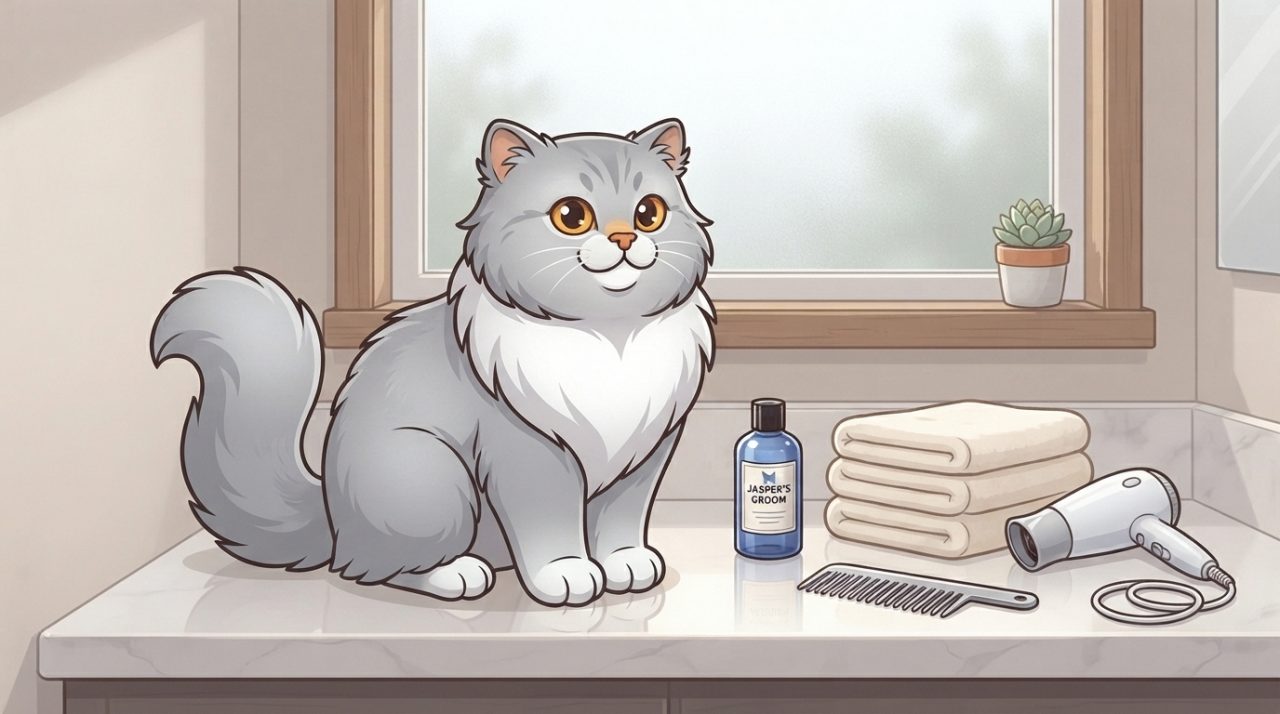
Here’s what I keep on hand for Jasper’s baths.
Shampoo formulated for cats – specifically a gentle, pH-balanced formula for long haired or Persian cats. Human shampoo, even gentle baby shampoo, has a different pH than what a cat’s skin needs. I use a shampoo designed for long coats specifically because it helps keep the fur from tangling during the rinse. Some owners swear by whitening shampoos for light colored Persians, which can help maintain that bright, clean look between baths.
A conditioning rinse or leave in conditioner – This is non-negotiable for me. Persian fur gets tangled during bathing it just does. A conditioner helps the coat rinse out cleanly, reduces static, and makes combing out after the bath so much easier. Without it, I’ve ended up with knots that required careful detangling for an hour.
A detachable shower head or a large plastic cup – You need a gentle, controlled water flow to rinse a Persian’s coat thoroughly. A detachable showerhead is my preference. It makes rinsing so much easier, especially around the neck and chest where the fur is densest.
Three to four towels – I’m not kidding about the towels. Persian cats hold a lot of water in that coat. You’ll go through them.
A non-slip mat for the sink or tub – Cats on slippery surfaces are stressed cats. A rubber mat gives them something to grip, which reduces panic significantly.
A wide tooth comb and a slicker brush – For post bath grooming once the coat is mostly dry.
A hairdryer with a low or cool setting – Persian cats should never air-dry. I’ll explain why in the drying section. Have your dryer ready to go.
Treats. Obviously.
Setting Up Your Bathing Space
Where you bathe your Persian cat matters more than you might expect. The setup can make the difference between a stressful experience and a manageable one.
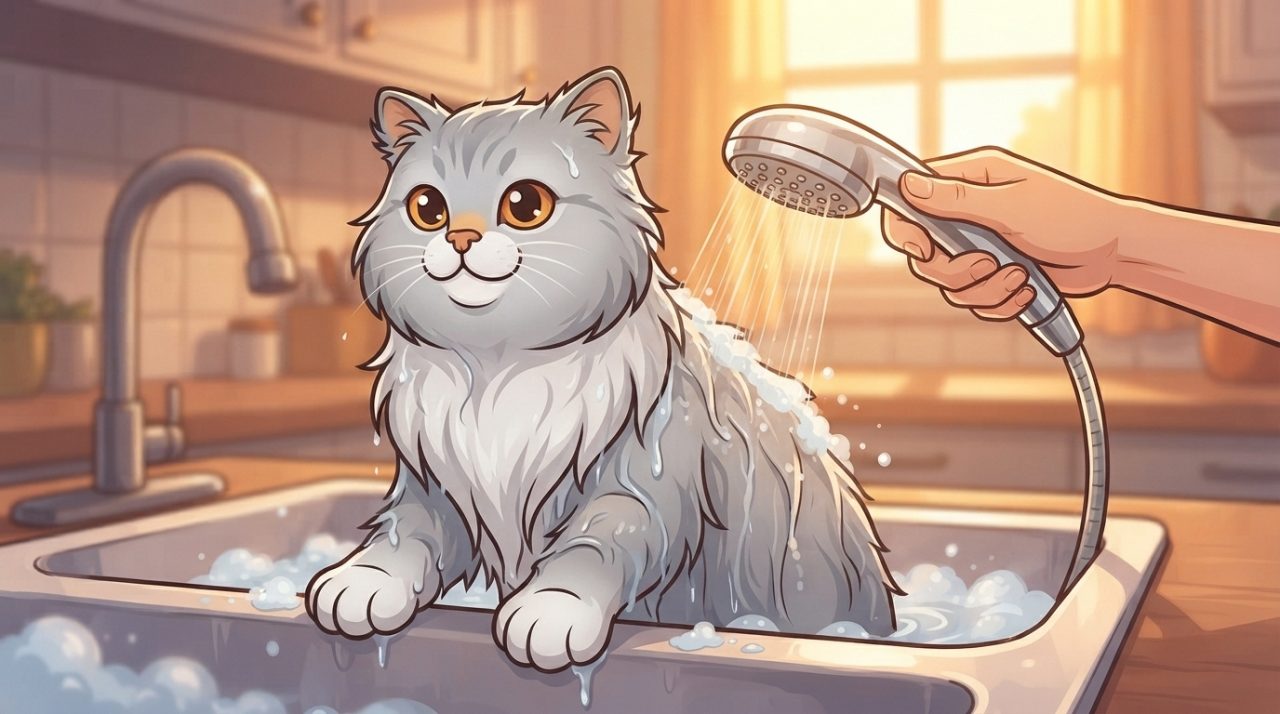
Most owners use either a deep kitchen sink or a bathtub. I started with the bathtub and switched to my kitchen sink about a year in, and it was a game changer. With Jasper in the sink, I’m standing upright (no back pain), I have the faucet right there, and he’s at a height where I can really see what I’m doing. The sink feels more contained to him, too less overwhelming than the open expanse of a tub.
That said, some Persians are too large for a standard kitchen sink by the time they’re fully grown, and plenty of owners prefer the tub. Do what works for your cat and your space.
A few setup tips,
Fill the sink or tub with a few inches of warm water before bringing your cat in – Running water can startle cats. If you fill it first, it’s quieter and less alarming. The temperature should feel comfortably warm on your wrist, not hot, not cold.
Close the bathroom door – Cats who panic during baths will bolt, and a wet Persian running through your house is a chaotic scenario you don’t want.
Keep the environment calm – This isn’t the time for kids running through, other pets scratching at the door, or a loud TV in the background. Soft, quiet, calm.
Have everything within arm’s reach – Once your hands are wet and your cat is in the water, you don’t want to be searching for anything.
One thing I always do before a bath, I gently comb through Jasper’s coat to remove any existing tangles or mats. Wet hair tangles more than dry hair, so starting with a tangle free coat makes the whole process easier. If I skip this step, I always regret it.
Step by Step – How to Bathe a Persian Cat at Home
Alright, here’s the actual process. Take a breath you’ve got this.
Getting Your Cat Into the Water
Bring your Persian into the bathroom calmly and confidently. Cats pick up on your energy, so if you’re anxious, they’ll be anxious. I know that sounds easier said than done, but it helps.
Lower your cat gently into the pre-filled sink or tub, keeping one hand on them at all times. Most cats will protest at first, some will try to climb out immediately. Hold them firmly but gently. Talk to them in a calm, low voice. The first minute is usually the hardest. Once they realize the water isn’t going to swallow them, many cats settle into a resigned acceptance.
Wetting the Coat
Using your cup or detachable showerhead, wet the coat slowly and thoroughly. Start at the back and work toward the neck to avoid pouring water directly over the face.
Persian fur repels water at first because of its density, so you’ll need to work the water in with your hands as you go. Really get down to the skin, especially around the legs, belly, and chest, which tend to be greasy spots.
Applying Shampoo
Use less shampoo than you think you need. It’s easy to over apply, and over applied shampoo is hard to rinse out fully. A good rule of thumb, dilute your shampoo a little in a cup of warm water before applying. It distributes more evenly and rinses out much more cleanly.
Work the shampoo through the coat in a downward motion, following the direction of hair growth. Avoid scrubbing in circular motions this causes tangles. Focus on the neck, chest, back, and belly, and use a very gentle touch around the rear end.
For the face, do not use shampoo near the eyes or nose. A damp washcloth is the safest way to wipe the facial area. Jasper has quite a flat face, and I always do his face separately with just warm water on a cloth, never letting shampoo anywhere near those eyes.
Rinsing Don’t Rush This Part
This is where most people make their biggest mistake, not rinsing long enough.
With a Persian’s coat, incomplete rinsing leaves shampoo residue that makes the coat look dull and feel sticky and it can irritate the skin. I always rinse for what feels like way too long and then rinse again. The water running off the coat should run completely clear before you move on.
Apply your conditioner after rinsing, work it through the coat, let it sit for a minute or two, then rinse again also thoroughly.

Drying Your Persian Cat – Don’t Skip This Step
Here’s something every new Persian cat owner needs to know, you cannot just towel off a Persian cat and call it done.
A Persian’s dense coat takes a very long time to dry on its own, and if it stays damp for hours, a few bad things can happen. Mildew like odors can develop in the coat. The dampness near the skin can cause skin irritation. And damp fur is much more prone to matting than dry fur, exactly the thing you were trying to avoid with the bath in the first place.
The right approach is to blow dry, and yes, most Persians can learn to tolerate it.
Step one – Towel dry as much as possible first – Press the towels against the coat rather than rubbing rubbing causes tangles. You’ll go through multiple towels. This is normal.
Step two – Use a hairdryer on a low or cool setting – I cannot stress enough – do not use high heat. It’s uncomfortable for the cat and can damage the coat. Low heat or cool air, held at a reasonable distance, directed at the coat in sections.
Step three – Comb as you dry – Using a wide tooth comb while drying helps the coat dry evenly, prevents tangles from forming, and leaves you with a beautifully fluffed out coat that looks like your Persian just stepped out of a show ring. Jasper looks absolutely ridiculous in the best possible way after a properly done blow dry like a cloud with a face.
The whole drying process can take 30 – 45 minutes for a fully coated Persian. Put on a podcast, settle in, and embrace it.
Common Persian Cat Bath Time Mistakes to Avoid
Even with the best intentions, it’s easy to stumble. Here are the mistakes I see most often most of which I’ve made myself,
Using water that’s too hot or too cold – Cats are sensitive to temperature. Always test the water on your wrist first. It should feel comfortable, like a warm bath for yourself.
Getting water in the ears – Moisture in the ear canal can cause issues. Use a small cotton ball in each ear to block water during the bath, and remove them afterward. Be careful and gentle.
Rushing the rinse – As mentioned, rinse longer than you think you need to. Left in shampoo is one of the most common reasons a Persian coat looks dull or feels tacky.
Skipping the pre bath comb – Always comb out tangles before the bath. Bathing a matted coat will make the mats significantly worse.
Bathing too frequently – Once every four to six weeks. More than that without a specific reason can dry out the skin.
Letting the cat air dry – Just don’t. Not with a Persian. Always blow dry.
Making bath time negative – Treats before, during (if your cat is treat motivated), and after. Keep your voice calm. End on a positive note whenever possible. The goal is that over time, bath time becomes stressful but fine, not a catastrophe.

FAQ: About Bathing Persian Cats
My Persian cat absolutely hates baths and fights the whole time. What can I do?
Some Persians are just more resistant than others, this is totally normal. A few things that help, start bathing them young if possible, since kittens adapt more easily than adult cats who’ve never been bathed. Use calming tools like a Feliway spray in the bathroom before bringing them in. Work very slowly, offering treats throughout. Some cats do better with a second person helping to keep them calm. If your cat’s stress is severe, talk to your vet. There are calming options that can help make the experience less overwhelming for very anxious cats.
Can I use dry shampoo or waterless shampoo on my Persian instead of a full bath? Waterless shampoos can be a great option for spot cleaning or refreshing the coat between full baths, but they’re not a replacement for actual bathing. They don’t remove oil buildup effectively enough to keep a Persian coat truly healthy. Think of them as a between bath touch up, not a substitute.
How do I bathe a Persian kitten for the first time?
Start small. The first few “baths” don’t need to be full baths, just get the kitten used to warm water. Wet a washcloth and gently rub it over their coat. Let them get used to the sink. Slowly work up to actual shampooing over a few sessions. Positive association is everything at this stage, so keep treats flowing and keep the sessions short.
What shampoo is best for a white Persian cat?
A brightening or whitening shampoo formulated for cats is a popular choice for white and light colored Persians. These help maintain that bright, clear coat and prevent yellowing. Always make sure whatever you choose is specifically formulated for cats, never use human whitening products.
Should I brush my Persian cat before or after a bath?
Both, actually. Comb through the coat before the bath to remove existing tangles, and then brush and comb again during the blow dry process to prevent new tangles from forming as the coat dries.
A Little Love Before You Go, From a Fellow Persian Cat Mama
Bath time with a Persian cat is one of those things that sounds overwhelming before you’ve done it and then gradually, bath by bath, becomes just another part of your routine together.
Jasper is never going to run excitedly toward the bathroom when he hears the water running. That is not in his nature, and I’ve made peace with it. But these days he stands still in the sink, accepts the shampoo, submits to the blow dryer with approximately seventy percent less drama than year one, and afterward coat perfectly fluffed, looking absolutely magnificent he struts to his favorite chair like he planned the whole thing.
If you’re just starting out, give yourself grace. The first bath will probably be messy and a little chaotic. The tenth will be so much easier. You’ll find the rhythm, your cat will find their version of tolerance, and before long you’ll wonder what you were so worried about.
If this guide helped you, I’d love to hear how your cat’s first bath went. Drop a comment below and tell me everything. And if you’ve got a trick that makes bath time easier that I haven’t mentioned here, I’m always learning.
Pin this for later, and happy bathing!
About the Author
Tabitha P. Bean is a Persian cat enthusiast, writer, and the proud owner of Jasper, her beloved male Persian cat. Through her love for Jasper, she enjoys sharing helpful tips and insights to help fellow cat parents give their fluffy companions a happy, healthy, and comfortable life.
