
Estimated read time: 10 – 13 minutes
Introduction
There’s a moment every Persian cat owner knows well. You reach down to pet your cat, your fingers sink into what should be a cloud of silky fur and instead you hit a wall of knots. Somewhere between last Tuesday and right now, your cat’s gorgeous coat has turned into a science experiment.
I’ve been there. I’ve been there more times than I’d like to admit. After three years of figuring out a Persian cat brushing routine that actually works, one that Jasper tolerates, that keeps his coat mat-free, and that doesn’t take up half my evening I finally feel like I have something worth sharing.
If you’re new to Persians or just new to the reality of that coat, this guide is for you. I’ll walk you through how often you actually need to brush, which tools are worth your money, and how to make the whole process less of a battle. By the end, you’ll have a clear plan you can start using today.
Why Persian Cat Coat Care Is Different From Other Breeds
Before we get into the how often and the which brush questions, it helps to understand why Persian cats need so much more grooming attention than your average cat.
Persian cats have what’s called a double coat, a dense, cottony undercoat beneath a long, silky topcoat. This combination is beautiful, but it’s also a recipe for matting if you ignore it. Unlike short haired breeds that can more or less groom themselves effectively, Persians simply cannot maintain that coat on their own. The fur is too long, too dense, and too prone to tangling.
The undercoat is the real troublemaker. As it sheds and it sheds constantly those loose hairs don’t fall away cleanly the way they do on a short haired cat. Instead, they get trapped in the topcoat. Over time, those trapped hairs twist together, especially in areas where there’s friction, behind the ears, under the armpits, around the collar area, and along the belly.
Left alone, those tangles become mats. And mats are more than just an aesthetic problem. Tight mats can pull on the skin uncomfortably, trap moisture and debris against the coat, and make your cat miserable. In serious cases, mats have to be carefully cut out and that’s a situation we all want to avoid.
The good news is that consistent brushing prevents almost all of this. Not occasional brushing. Not “when I notice it looks messy” brushing. Consistent, routine brushing and that’s exactly what we’re going to map out.

How Often Should You Brush a Persian Cat?
Here’s the honest answer, daily brushing is the gold standard for Persian cats. I know that sounds like a lot. When I first got Jasper, I thought people who said “brush your Persian every day” were being dramatic. They were not being dramatic.
A daily brushing session doesn’t have to be long. In fact, if you’re doing it consistently, five to ten minutes is often enough to keep things tangle free. It’s the skipping that causes the long sessions, because every day you skip, the undercoat has another chance to trap shed hairs and start forming knots.
That said, I want to be realistic with you. Life happens. You get busy, your cat is in a mood, you forget. Here’s how I think about the minimum realistic schedule,
Daily (ideal) – Light maintenance brushing, 5–10 minutes. Quick pass through the whole coat with a soft slicker brush. Catches shed hairs before they mat. Jasper and I do this in the evenings while I watch TV, he’s gotten so used to it that he’ll actually hop up next to me and wait.
Every other day (workable for most Persians) – You can maintain a tangle free coat on a every other day schedule if you’re thorough each time. Increase your session length to 15–20 minutes and make sure you’re getting into all the friction zones armpits, belly, behind the ears.
Three times per week (minimum floor) – Anything less than three times a week and most Persians will start developing tangles, especially if they’re active, rub against furniture, or have particularly dense coats. If you’re going to do three sessions a week, make each one count go slow, be methodical.
Once a week – This is not enough for most Persian cats. I’ve tried. By session two at the one week mark, Jasper already had small knots forming behind his ears. Once weekly brushing works for some cats with lighter, less dense coats, but it’s a risk I wouldn’t take.
The frequency that works for your cat will also depend on the season. Persian cats tend to shed more heavily in spring and fall as they transition between coats. During those periods, bump up your brushing frequency by at least one session per week.
The Essential Brushing Tools for Persian Cats
Not all brushes are created equal when it comes to Persian cat coat care. I’ve bought a lot of tools over the years, some genuinely helpful, some completely useless for long haired coats. Here’s what actually earns a place in my grooming kit.
Wide Tooth Comb
If you only buy one tool, make it a wide tooth metal comb. This is the single most important grooming tool for a Persian cat, and it’s what most beginners overlook in favor of fancy brushes.
A wide tooth comb lets you get all the way down to the skin and through the full depth of the coat. Brushes, even good ones, often skim the surface of a long coat without detecting the small tangles forming underneath. A comb will catch those tangles before they tighten into real mats.
Look for a comb with rounded teeth tips so you’re not scratching your cat’s skin. Stainless steel teeth hold up much better than plastic over time and don’t generate static the way plastic can. Some combs are dual sided wider teeth on one side, closer set teeth on the other and these are especially versatile for Persian coats.
I use the wide side first to work through the coat in sections, then follow up with the closer set side to catch finer tangles. It’s become second nature at this point.
Slicker Brush
A slicker brush has fine, short wire pins set into a flexible cushioned pad. It’s excellent for the topcoat, smoothing the fur, removing loose hairs that have already detached, and giving the coat that finished, fluffy look after a grooming session.
The key thing to know about slicker brushes – they’re a finishing tool for Persian cats, not a primary detangling tool. If you use a slicker brush on a mat or significant tangle, you’ll break hairs and potentially pull at the skin without actually resolving the knot. Use your wide tooth comb first, then follow up with the slicker brush once the coat is tangle free.
Choose a slicker brush with flexible pins rather than rigid ones this is gentler on the skin and better for getting through dense long fur without uncomfortable pulling. The paddle size matters too, a larger paddle covers more ground and makes the session faster, which Jasper definitely appreciates.
Dematting Comb or Mat Splitter
Even with a diligent routine, mats happen. A dematting comb sometimes called a mat splitter or mat rake is designed specifically for this problem. It has fewer, wider teeth with slightly curved or serrated edges that can work through a mat by splitting it into smaller sections rather than trying to drag it apart all at once.
This is not a tool you use in every grooming session. It lives in the kit for when you discover a mat that your regular comb can’t work through gently. Used carefully, a dematting tool can save you from the only alternative, which is scissors.
Fine Tooth Comb (for Face and Paws)
Persian cats have flat faces and the fur around their face, chin, and paws is finer and shorter than the body coat. A fine tooth comb smaller and with closer set teeth works better in these areas than a wide comb or brush.
Jasper is particularly prone to getting small tangles in the fur just behind his ears and along his cheeks. A fine tooth comb lets me work through those areas with the precision they need without disturbing the longer body fur.
Grooming Spray or Detangling Spray
This isn’t a brush, but it belongs in the conversation. A light grooming spray designed for cats, always can make a significant difference in how smoothly your brushing sessions go. Spritzed lightly on the coat before brushing, it helps reduce static, add slip to the fur, and makes tangles easier to work through without pulling.
I started using a detangling spray about a year into Jasper’s grooming routine and genuinely wish I’d started sooner. Sessions are faster, he’s more comfortable, and his coat looks better between brushings.
Never use human hair products on your cat’s coat, the ingredients aren’t safe for cats who groom themselves.
Step by Step – How to Brush a Persian Cat
Knowing which tools to use is half the battle. The other half is knowing how to use them especially when you’re working with a coat this dense and a cat that may or may not be a cooperative participant.
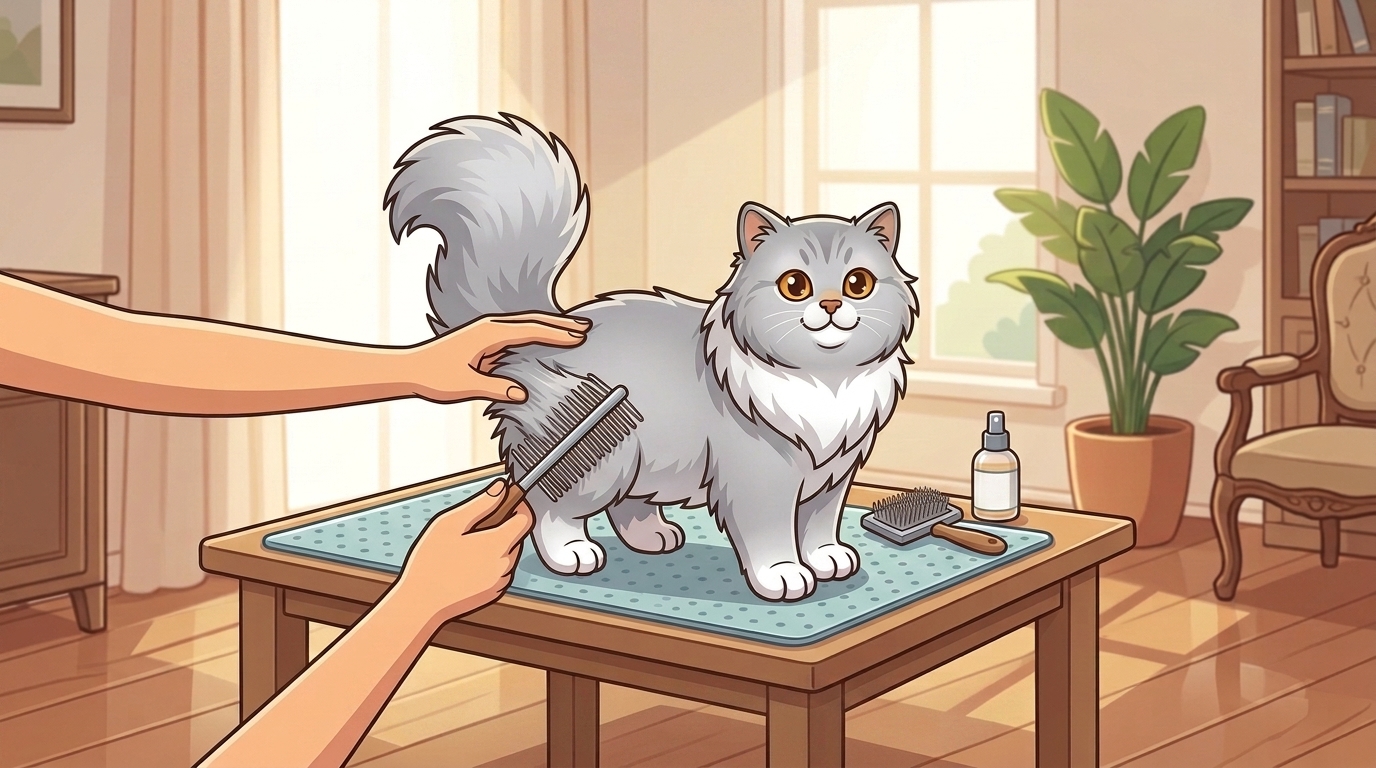
Start with a calm environment – Choose a time when your cat is naturally relaxed after a meal, during a rest period, in a quiet room. Put a non-slip mat on your lap or on a table so your cat feels stable. Rushing a grooming session because you’re trying to fit it between other things is a recipe for a stressed cat and a half finished job.
Begin with the wide tooth comb, working in sections – Don’t try to comb the whole cat at once. Work in small sections start at the hindquarters and work your way forward, or start at one side and work to the other. Holding the fur above the area you’re combing with one hand while you comb with the other (called “supporting the root”) makes the process much more comfortable for your cat by reducing skin pull.
Go with the grain, then against it – Comb first in the direction of hair growth to work through the length of the coat, then lightly against the grain to lift the undercoat and check for hidden tangles. If you hit resistance, don’t force it to stop, assess whether it’s a tangle you can work through gently or something that needs a dematting comb, and work accordingly.
Address tangles before they become mats – When you hit a small tangle with your comb, work the very tip of the comb teeth through the outer edge of the tangle first, loosening it from the outside in. Never try to drag a comb straight through a knot. This is painful for your cat and breaks hair unnecessarily.
Finish with the slicker brush – Once you’ve combed through the whole coat and everything is tangle free, do a pass with the slicker brush. This removes any remaining loose hairs, smooths the topcoat, and leaves the fur looking its best. It also feels good to the cat, most Persians seem to genuinely enjoy this part.
Don’t forget the underbelly and armpits – These are the areas most owners miss and most mats form. Gently lift your cat’s front legs to access the armpit area, and turn your cat (gently, with good support) to access the belly. If your cat objects to belly brushing, keep sessions there very short and build tolerance over time.

Managing Mat Emergencies
Even the most diligent Persian cat brushing routine will occasionally meet a mat you didn’t catch in time. Here’s how to handle it without panicking and without reaching straight for the scissors.
First, don’t pull. This is the most important rule. Yanking at a mat causes pain and damages the coat. Worse, it makes your cat associate grooming with bad experiences, which makes every future session harder.
Apply a small amount of detangling spray to the mat and let it sit for a minute or two. Then use your fingers to gently tease the outer edges of the mat apart, your fingers are more sensitive than any tool and will catch resistance before it becomes painful. Work from the tips inward, very slowly.
Once you’ve loosened the mat as much as possible by hand, try working through it with your dematting comb, starting from the outer edge. Small, controlled strokes. If the mat is releasing, keep going. If it’s genuinely not moving and your cat is distressed, it’s time for scissors and if you’re not confident using scissors near cat skin, this is a job for a professional groomer.
Tight, extensive matting near the skin should always be handled by a professional. What looks like a few mats can sometimes involve much more fur than is visible from the surface, and improper removal can injure the skin.
How to Make Brushing Something Your Persian Cat Actually Tolerates
Here’s where I want to be straight with you, some Persian cats love being groomed. Jasper falls into this category now, though it took a while. Other Persians tolerate it with various degrees of resentment. Very few outright refuse but if you have a cat who does, there are ways to improve the situation.
Start young if you can – Kittens who are introduced to brushing early, even light, brief sessions with no particular goal other than getting them comfortable with the sensation almost always become easier adult cats to groom. If you’ve already got an adult Persian who’s brush resistant, this tip isn’t helpful right now, but keep it in mind if you ever add a kitten.
Keep early sessions short – If your cat isn’t used to brushing, start with one or two minutes and stop before they start showing signs of stress (tail flicking, skin twitching, turning to look at the brush). End on a calm, positive note. Build duration over weeks, not days.
Pair brushing with something your cat loves – For Jasper, that’s a few small treats after a session. For some cats, it’s play immediately afterward. The association between “brushing happens” and “good thing follows” takes time to build but makes a real difference.
Use a gentle touch – Sounds obvious, but it bears saying, lighter pressure is almost always more effective than pushing harder. A light touch with a comb detangles better than a forceful drag, and it’s far more comfortable for your cat.
Let your cat have some control – If your cat walks away during a session, don’t force it. Let them take a break, redirect with a treat, and try again. A cat who feels trapped during grooming will become increasingly resistant. A cat who figures out that grooming always ends when they need it will often become much more cooperative over time.

FAQ: About Persian Cat Brushing Routine
How long should a Persian cat brushing session take?
For daily maintenance brushing on a tangle free coat, five to ten minutes is usually enough. If you’re brushing every other day or three times a week, plan for fifteen to twenty minutes to be thorough. Sessions get much faster once you and your cat are in a consistent routine the coat stays cleaner and your technique gets more efficient.
What’s the best brush for a Persian cat?
The most important tool isn’t actually a brush, it’s a wide tooth metal comb. A comb gets all the way through the dense coat to the skin, where tangles form. Brushes (particularly slicker brushes) are excellent finishing tools but shouldn’t be your primary detangling tool for Persian fur. A combination of a wide tooth comb, a fine tooth comb for face and paw areas, and a slicker brush for finishing covers most needs.
My Persian cat hates being brushed. What can I do?
Start with very short sessions, even just one or two minutes and stop before your cat reaches its stress threshold. Always end on a calm moment, never when your cat is actively struggling. Pair sessions with something your cat enjoys, like a small treat or a play session afterward. Gradually build duration over weeks. If your cat has had negative grooming experiences in the past (particularly painful mat removal), it may take longer to rebuild their confidence.
Can I bathe my Persian cat instead of brushing?
Bathing is a useful part of Persian cat care, but it’s not a substitute for brushing and brushing before a bath is actually essential. Washing a coated Persian with existing tangles can cause the fur to mat even more tightly as it dries. Always brush thoroughly before bathing. After a bath, the coat will need to be carefully dried and brushed out again before it sets.
How do I brush a Persian cat’s belly without getting scratched?
Belly brushing takes patience and trust building. Start with very brief touches to the belly area during regular sessions just a few strokes and increase gradually over time. Keep the comb light and use short strokes rather than long passes that might feel threatening. Some cats will always object to belly brushing; for these cats, focus on preventing mats in that area through more frequent body brushing that reaches the belly fur from the sides.
A Little Love Before You Go, From a Fellow Persian Cat Mama
If I could go back and give myself one piece of advice before bringing Jasper home, it would be this: don’t wait until the coat is a problem to figure out your brushing routine. Start on day one, keep sessions positive and consistent, and invest in a good metal comb.
The Persian cat brushing routine that works for Jasper didn’t appear overnight. It evolved over months of trial and error, different tools, different timing, different approaches until we landed on something that fits both of our lives. Now it’s just part of our evenings, the same way a cup of tea or a chapter of a book is. He’s calmer for it. His coat is genuinely beautiful. And honestly, I think he’d be offended if I skipped a session at this point.
Your Persian’s coat is one of the most distinctive things about them. It’s worth taking care of. You don’t have to be perfect at it right away. You just have to be consistent.
If this guide helped you, I’d love to hear about it in the comments. Tell me about your cat, your grooming wins, or the mat situation you’re currently waging war against. We’re all in this together.
And if you found this useful, bookmark this page or pin it for later. It’s a good one to come back to when you’re trying to remember which comb does what.
About the Author
Tabitha P. Bean is a Persian cat enthusiast, writer, and the proud owner of Jasper, her beloved male Persian cat. Through her love for Jasper, she enjoys sharing helpful tips and insights to help fellow cat parents give their fluffy companions a happy, healthy, and comfortable life.
