

Introduction
The first time Luna chirped at a bird through the living room window, I genuinely laughed out loud. It sounded like she was trying to speak to Bird, this rapid fire stuttering sound, somewhere between a squirrel and a broken kazoo. I had no idea cats could even make that noise. I thought something was wrong with her.
Fast forward five years, and I’ve become something of an amateur Maine Coon translator. If you share your home with one of these magnificent, ridiculous cats, you already know they are not quiet. Maine Coons chirp, trill, chatter, and make sounds that have no business coming out of a cat. And if you’ve ever caught yourself wondering “why does my Maine Coon chirp so much?” you are absolutely in the right place.
In this article, I’m breaking down every weird noise Luna makes and what the science (and lived experience) says it all means. By the end, you’ll understand your Maine Coon’s vocalizations way better than I did when I was frantically Googling “is my cat broken” at 7am.
What Exactly Is a Maine Coon Chirp And Is It Different From a Regular Meow?
Let’s get the basics straight first, because Maine Coon sounds are genuinely their own category.
A chirp is a short, high pitched sound almost bird-like. It’s quick, usually one syllable, and has a little upward lilt at the end. Think of it like your cat saying “hi!” but in a frequency you didn’t know cats could reach.
A trill is related but different. It’s that rolling, purring meets talking sound like a tiny motor starting up. Luna does this one when she walks into a room and wants to announce herself. It’s her version of “hey, I’m here, acknowledge me.”
Chattering is the dramatic cousin. That rapid jaw clicking sound Maine Coons make when they spot a bird or squirrel? That’s chattering. It’s almost mechanical like their mouth is buffering.
A regular meow is none of these things. Standard meows are longer, more drawn out, and honestly less interesting. Most adult cats actually stop meowing at other cats and reserve that sound exclusively for humans. But chirps, trills, and chatters? Those are a different communication system entirely.
Maine Coons are especially vocal compared to most breeds. It’s part of their personality. They’re chatty, social, opinionated cats who want you to know exactly what’s on their mind. If you were hoping for a silent, mysterious cat who stares at you from across the room, wrong breed, my friend.
The Science Behind Maine Coon Chirping – Why Do They Do It?
Here’s where it gets genuinely fascinating.
Chirping Is Inherited From Their Wild Ancestors
Cats in the wild use a variety of vocalizations to communicate and chirping, specifically, has roots in hunting behavior. Some animal behaviorists believe chirping and chattering developed as a way for cats to mimic bird or rodent sounds, potentially to lure prey closer. Others think it’s simply a reaction to a frustrated predatory instinct, your cat sees something it wants to catch and can’t, and the chirp is the overflow valve.
Luna does her most dramatic chirping at the squirrels on our back fence. She’ll press her nose against the glass, tail lashing, and make this absolutely unhinged chittering noise for a solid five minutes. Pure frustration. She wants that squirrel so badly and the window keeps ruining everything.
Trilling Is Learned From Mom
This one I find incredibly sweet. Kittens learn the trill vocalization from their mothers. Mother cats trill to get their kittens’ attention. It’s a “hey, follow me” or “pay attention” sound. Kittens who learn this carry it into adulthood and use it with the humans they bond with.
So when Luna walks into my home office and trills at me, she’s essentially treating me like her kitten. She learned to communicate that way with her mom, and now she uses it on me. I’m choosing to find that endearing rather than slightly embarrassing.
Maine Coons Are Genetically More Vocal
Breed matters here. Maine Coons were historically working cats, they lived in barns and on ships, where communication with humans was practical and important. Cats who were sociable and communicative were more likely to be kept, fed, and to reproduce. Over generations, this is selected for cats who actually want to talk to people.
Compare a Maine Coon to a Russian Blue or a British Shorthair, and the difference in vocalization is stark. Maine Coons have more to say and more ways to say it.

Decoding the Different Maine Coon Chirps – What Each Sound Means
Not all chirps are created equal. Once you start paying attention, you’ll realize your Maine Coon has a whole vocabulary and it’s surprisingly consistent.
The Greeting Trill
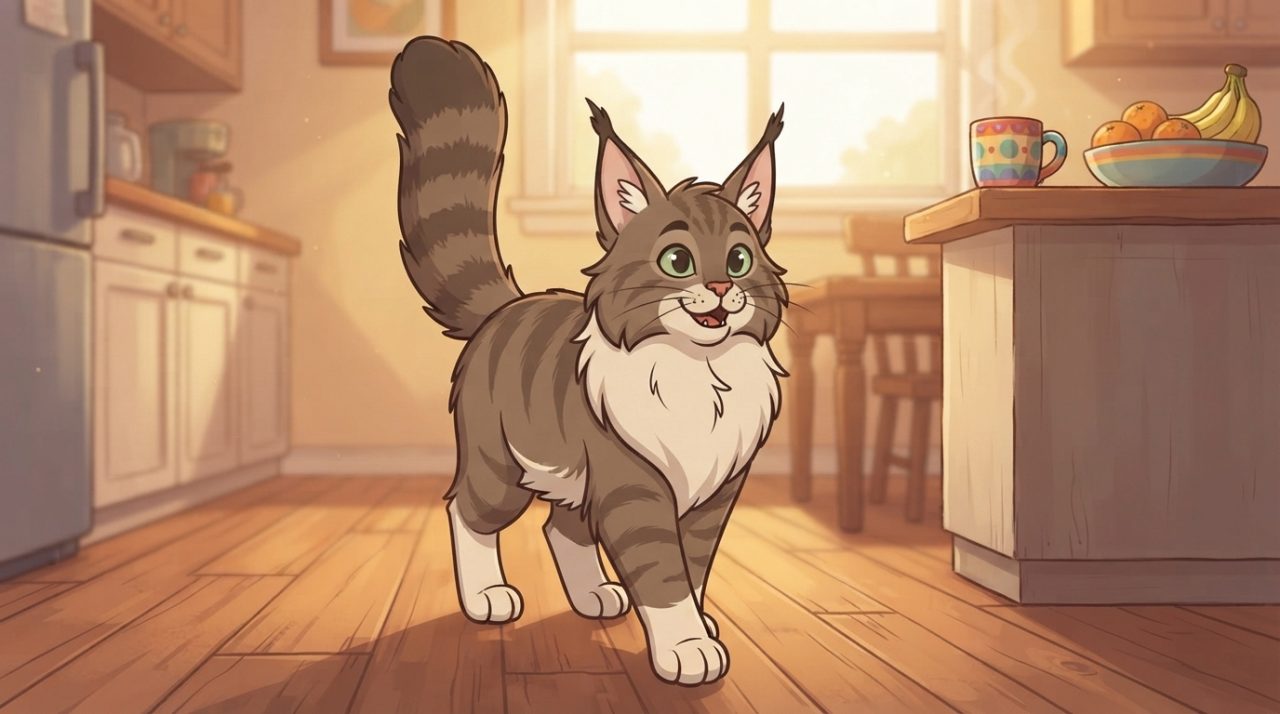
This is the one Luna does every single morning when I walk into the kitchen. It’s a soft, rolling sound, usually accompanied by her walking toward me with her tail straight up. Translation: “Good morning. I see you. I approve of your presence. Now feed me.”
It’s affectionate and social. Your Maine Coon is using the same sound their mom used to greet them. If your cat does this to you, congratulations you’ve been adopted.
The Attention Chirp
Different from the greeting trill, this one is more insistent. It’s shorter, sharper, and often repeated. Luna does this when I’m on a phone call and she has decided that my attention should belong to her.
If your Maine Coon is chirping at you repeatedly while staring at you directly, they want something. Food, playtime, the door opened, you acknowledge that they exist. The direct eye contact is the tell.
The Hunting Chatter
This is the wild one. Jaw clicking, rapid stuttering sounds, sometimes accompanied by a tense body and focused stare. Almost always directed at birds, squirrels, or insects through a window.
This is predatory frustration. Your Maine Coon wants to hunt that thing and cannot. The chattering seems to happen involuntarily like their body is running the “catch prey” program even though the physical action is impossible.
Some cats also do a lighter version of this with toys. Luna does a little chitter when I pull out the feather wand. She’s already in hunt mode before we even start playing.
The Conversational Chirp Meow Hybrid
Maine Coons are big on conversation. If you talk to your cat and they respond with a chirpy little sound not quite a meow, not quite a trill they’re engaging with you. This is a back and forth communication thing.
I have full conversations with Luna this way. I’ll ask her how her day was (don’t judge me), and she’ll chirp back, and I’ll respond, and she’ll chirp again. We do this for like three minutes sometimes. My husband thinks we’re both losing it.
The Distressed or Demanding Chirp
Context is everything. A chirp can also be a signal that something is wrong or that your cat is very unhappy about a situation. If the chirp is high pitched and repeated, and your cat seems agitated pacing, ears slightly back, tail moving fast, something is bothering them.
Luna does this when her water bowl is empty. One look at the situation and the sound makes it abundantly clear: this is unacceptable and you need to fix it immediately.
Why Does My Maine Coon Chirp at Me Specifically?
This question comes up a lot, and I think it’s one of the sweetest things about Maine Coons.
Your cat is chirping at you because they trust you and want to communicate with you. Cats in the wild don’t walk up to random animals and chirp at them; it’s a social behavior directed at beings they feel bonded to.
Maine Coons, more than most breeds, genuinely enjoy human company. They’re often called “dog-like” for this reason they follow you around, want to be in the same room, and actively seek interaction. The chirping is an extension of that social drive.
If Luna chirps at me and I chirp back (yes, I do this, yes it works), she gets visibly more engaged. Her ears perk up, she comes closer, she does the biscuit making thing on the couch cushion. She’s delighted that I’m playing along.
There’s also a strong attention component. Maine Coons are smart cats. They figure out very quickly what works on their humans. If chirping at you gets a response, any response they will continue to chirp at you. You’ve been trained. We’ve all been trained.
Is Maine Coon Chirping a Sign of Distress? When to Pay Attention
Most of the time, chirping is completely normal and healthy. But there are situations where unusual vocalizations can signal something worth investigating.
When Chirping Increases Suddenly
If your Maine Coon wasn’t particularly vocal and suddenly starts chirping a lot especially if it’s at odd hours, seems anxious, or is accompanied by other behavioral changes it’s worth a vet visit. Increased vocalization can sometimes indicate:
- Hyperthyroidism – (especially in older cats) an overactive thyroid causes restlessness and increased vocalization
- Cognitive dysfunction – in senior cats similar to dementia, can cause disorientation and nighttime yowling
- Pain or discomfort – cats in pain sometimes vocalize more
- Vision or hearing loss – cats who can’t see or hear well may vocalize more to orient themselves
Luna went through a phase around age four where she was chirping way more than usual, especially at night. Turned out she had a mild UTI that was causing her discomfort. One round of antibiotics and she went back to her normal (still very chatty) baseline.
When the Sound Changes Quality
Pay attention to how your Maine Coon sounds, not just that they’re making sounds. A chirp that suddenly sounds strained, raspy, or hoarse could indicate a respiratory issue or a problem with their throat or larynx.
When Chirping Is Accompanied by Other Symptoms
Chirping alone is almost always fine. Chirping plus lethargy, loss of appetite, weight changes, or hiding behavior is a combination that warrants attention. Trust your gut you know your cat’s baseline better than anyone.
How to Encourage (or Manage) Your Maine Coon’s Chirping
Some owners absolutely love the chatter. Others… have neighbors. Either way, here’s what actually works.
If You Want More Chirping and Interaction
- Talk back. I’m serious. When Luna chirps, I chirp back. She loves it. You can also use a soft, rising tone mimicking the shape of a trill. Your cat will think you’re brilliant.
- Make eye contact and blink slowly. Slow blinks are the cat equivalent of a warm smile. Pairing this with responding to chirps builds trust and encourages more vocalization.
- Interactive play. The feather wand, the laser pointer, puzzle toys, anything that activates their hunting instinct also activates their chirping. Luna is most vocal during and right before play sessions.
- Window perches near bird feeders. If you want to hear chattering in particular, set up a bird feeder outside a window your cat can easily see. It’s basically cat TV, and the commentary is nonstop.
If You Need to Calm the Chirping Down
Maine Coons who are bored, under stimulated, or anxious will chirp more. The solution is almost always addressing the underlying cause:
- More playtime. A tired Maine Coon is a quieter Maine Coon. Twenty to thirty minutes of active play per day makes a real difference.
- Environmental enrichment. Cat trees, puzzle feeders, hiding spots, window perches give them things to do so they’re not narrating their boredom at you.
- Routine. Maine Coons do well with predictable schedules. Feeding, play, and sleep at roughly the same times each day reduces anxious vocalization.
- A companion. If your Maine Coon is home alone for long stretches and is very vocal, they may be lonely. These are social cats. A second cat (or even a confident dog) can help.
Maine Coon Chirping vs. Other Breeds – Why Is My Cat So Extra?
Hands down, Maine Coons are some of the most vocal domestic cats you’ll encounter. But they’re not the most vocal. That title usually goes to Siamese, Burmese, or Oriental Shorthairs, who meow loudly and constantly.
What makes Maine Coons distinctive is the variety of sounds. They don’t just meow more, they have a wider range of vocalizations than most breeds. Chirps, trills, chatters, warbles, and hybrid sounds that don’t fit neatly into any category.
Part of this comes back to their intelligence. Maine Coons are genuinely smart cats, and smart cats figure out that different sounds produce different results. Luna has a specific chirp for “I want to go upstairs” that is completely different from her “I am interested in what you are eating” chirp. I didn’t teach her these distinctions. She developed them.
The other factor is their social nature. Maine Coons were bred to work alongside humans. They want to communicate. The sounds are just them doing what comes naturally.
Frequently Asked Questions
Why does my Maine Coon chirp at birds?
This is hunting behavior specifically, the frustration response when a cat spots prey they can’t reach. The chirping and chattering you hear when your Maine Coon watches birds through a window is their predatory instinct activating without an outlet. It’s completely normal and harmless. Some researchers also think the sounds may mimic bird calls as a lure, though the jury’s still out on that one.
Is it normal for Maine Coons to chirp instead of meow?
Absolutely. Maine Coons are known for having a more diverse vocal repertoire than most breeds, and many of them chirp, trill, and chatter far more than they produce traditional meows. Some Maine Coon owners say their cat almost never does a standard meow just an assortment of chirps and warbles. This is totally normal for the breed.
Why does my Maine Coon chirp when I come home?
Your cat is greeting you. The trill chirp that Maine Coons do when their person walks in is a social greeting behavior the same sound mother cats use with their kittens. It means your cat is happy you’re back and wants to acknowledge you. It’s one of the sweetest things these cats do, honestly.
Can I teach my Maine Coon to chirp more or less?
You can encourage more chirping by talking to your cat, responding to their vocalizations, and engaging in interactive play. You can reduce excessive chirping by addressing boredom or anxiety, more playtime, environmental enrichment, and a consistent routine all help. You can’t really train a Maine Coon out of chirping altogether, and you probably wouldn’t want to.
Why does my Maine Coon chirp at night?
Occasional nighttime chirping is normal, especially if your cat is watching something outside or wants attention. Frequent, distressed sounding nighttime vocalization especially in older cats can indicate cognitive decline, hyperthyroidism, or another health issue. If your Maine Coon suddenly starts making a lot of noise at night and it’s out of character, a vet check is a good idea.
Do all Maine Coons chirp?
Most do, but not all Maine Coons are equally vocal. Personality varies a lot within the breed. Some are total chatterboxes (Luna), and some are relatively quiet, they might chirp occasionally but won’t narrate their entire day at you. A lot depends on how they were socialized as kittens and their individual temperament.
One More Thing Before You Go From One Maine Coon Mom to Another
If your Maine Coon chirps, trills, and chatters at you constantly welcome to the club. These sounds aren’t random noise. They’re a whole language, and once you start paying attention, you’ll realize your cat is actually saying a lot.
Luna has taught me that the chirp at the window means frustration, the morning trill means “good morning, human,” the rapid chirp chirp chirp while staring at me means “fix this problem immediately,” and the soft warble when I’m working means “I am here and I love you and also pay attention to me.”
Learning your Maine Coon’s specific sounds takes time, but it’s one of the most rewarding parts of having this breed. They genuinely want to communicate with you. All you have to do is listen and maybe chirp back.
I’d love to hear what sounds your Maine Coon makes. Drop a comment below and tell me the weirdest noise your cat has ever produced. I promise nothing will surprise me at this point.
Nellie J. Wilson, Editor & Maine Coon Mom
